Journal ·
What is a motion platform?
A motion platform is a machine that moves what you sit in, the seat alone on some rigs and the whole cockpit on others, so that your body feels the motion the screen shows. It moves you on some or all of six axes, and its DOF number is how many of those six it can move you in. ARK's PDK (Portal Development Kit) is a six-axis motion platform built on patented enhancements to the Stewart platform.
How does a motion platform work?
A degree of freedom (DOF) is one independent way a body can move: three translations, surge (forward and back), sway (side to side) and heave (up and down), and three rotations, roll, pitch and yaw. The number counts axes, not actuators. Four actuators under the corners of a cockpit make three axes; six legs working in parallel make six.
A 2DOF platform tilts you on pitch and roll, a 3DOF platform adds heave or yaw, and a 6DOF platform moves you on all six. What each layout lets you feel, axis by axis, is in Two axes, three or six.
A Stewart platform, the layout of the PDK, puts six actuators between a fixed base and a moving top, and solves each pose from all six at once rather than from six axes stacked in series. With the legs in parallel, every leg shares every load, so the machine is stiff for its mass: the property that decides whether a motion cue arrives crisp or soft. The Stewart platform page takes it apart.
How does it turn a game into motion?
The game sends telemetry, and the platform has to turn it into movement it can actually make. Accelerate for ten seconds in a game and the car has moved several hundred metres; the platform has a fraction of a metre. Motion cueing is the set of filters that decides which parts of that motion you are given, which are traded for something you cannot distinguish from it, and which are quietly dropped.
Short, sharp events, such as kerbs, surface texture and the first instant of a braking event, are reproduced by moving, because the platform has the travel for them. Sustained acceleration is substituted: the onset is given by moving, and the sustain is borrowed from gravity by tilting. The return to centre is made slow enough to sit under perception. How that hand-over is tuned is motion cueing.
The cue also has to arrive on time. The PDK's latency is under 1 ms, from the game's telemetry reaching the platform to the actuator beginning to move; the latency page names both points.
For existing games, a telemetry tool does the translating: FlyPT Mover, a free third-party tool that translates game telemetry into platform motion, written and maintained by FlyPT Mover, not by ARK Dynamics (software integration).
What is inside one?
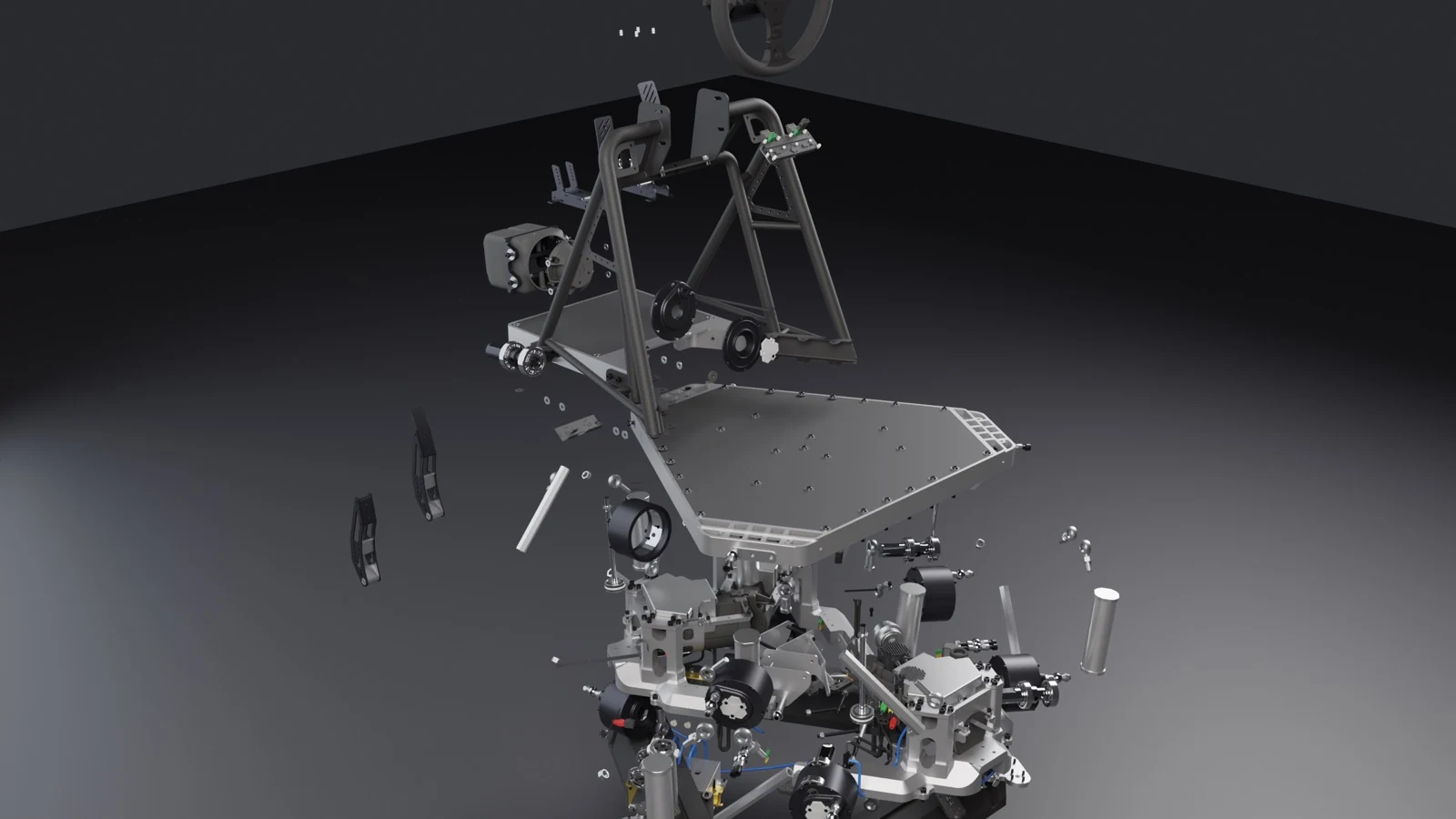
On the PDK, six direct-drive motors move the six legs, with no transmission in the load path: no belt to stretch, no gearbox to introduce backlash, nothing that wears into play over time.
Each motor carries a 21-bit magnetic encoder, 2,097,152 positions per revolution. Every axis is closed on its encoder, so the difference between where the platform was told to be and where it actually is exists as a number the controller acts on (closed-loop control).
The standing weight does not sit on the motors: three pneumatic cylinders carry it. So the PDK has nine legs in all. Six are motor-driven and produce every degree of freedom; three are pneumatic and do nothing but hold the platform up (passive weight compensation).
It fits a room. The platform is 1.00 × 1.00 m on its own feet, or a 1.57 m circle on the extension feet, and its rated payload is 250 kg in total, everything it carries, rider included (room and power).
What is a motion platform used for?
The same hardware serves very different fields. What changes from one to the next is not the hardware: it is what you mount on it, what drives it, and which of its properties you care about.
In sim racing, six direct-drive legs move the whole cockpit through all six degrees of freedom at once. In flight simulation, all six matter, because flying is mostly slow attitude with fast texture written on top of it. Research needs citable specifications, reproducible motion delivery and an open interface. The industries pages describe twelve fields, one page each.
What can a motion platform not do?
It cannot reproduce sustained acceleration. No platform does, not even a full-flight simulator: a platform can accelerate you briefly, then it runs out of room, and gravity stands in for the rest. That substitution is why two rigs with identical actuators, identical envelopes and identical latency can feel entirely different. The difference is almost always the cueing.
The PDK is not a certified training device. It is supplied as a research and engineering instrument, not a certified Flight Training Device or Full Flight Simulator, and a programme that needs a type-rated Level B, C or D device needs a qualified simulator.
What should you read next?
This post defines the machine. Two axes, three or six covers what each layout lets you feel. Before you buy a motion platform sets out the questions to ask any maker. How much room and power a motion platform needs covers the floor and the mains. Riders' own reactions are on See it move.
- Under 1 ms: from the game's telemetry reaching the platform to the actuator beginning to move ark-dynamics.com/technology/latency
- 21-bit encoders: 221 = 2,097,152 positions per revolution, checked by calculation ark-dynamics.com/technology
- Nine legs, three of them pneumatic ark-dynamics.com/technology/passive-weight-compensation
- Footprint: 1.00 × 1.00 m on its own feet, a 1.57 m circle on the extension feet ark-dynamics.com/faq
- 250 kg: the rated total payload, rider included ark-dynamics.com/safety
- Patent CA 3217174 C ark-dynamics.com/development-kits
Every PDK build starts with the same six-axis platform.