The maths runs backwards
Working out leg lengths from a desired pose is tractable. Working out the pose from six measured leg lengths is the hard direction, and a platform that wants to know where it truly is has to solve it continuously.
Engineering · Architecture
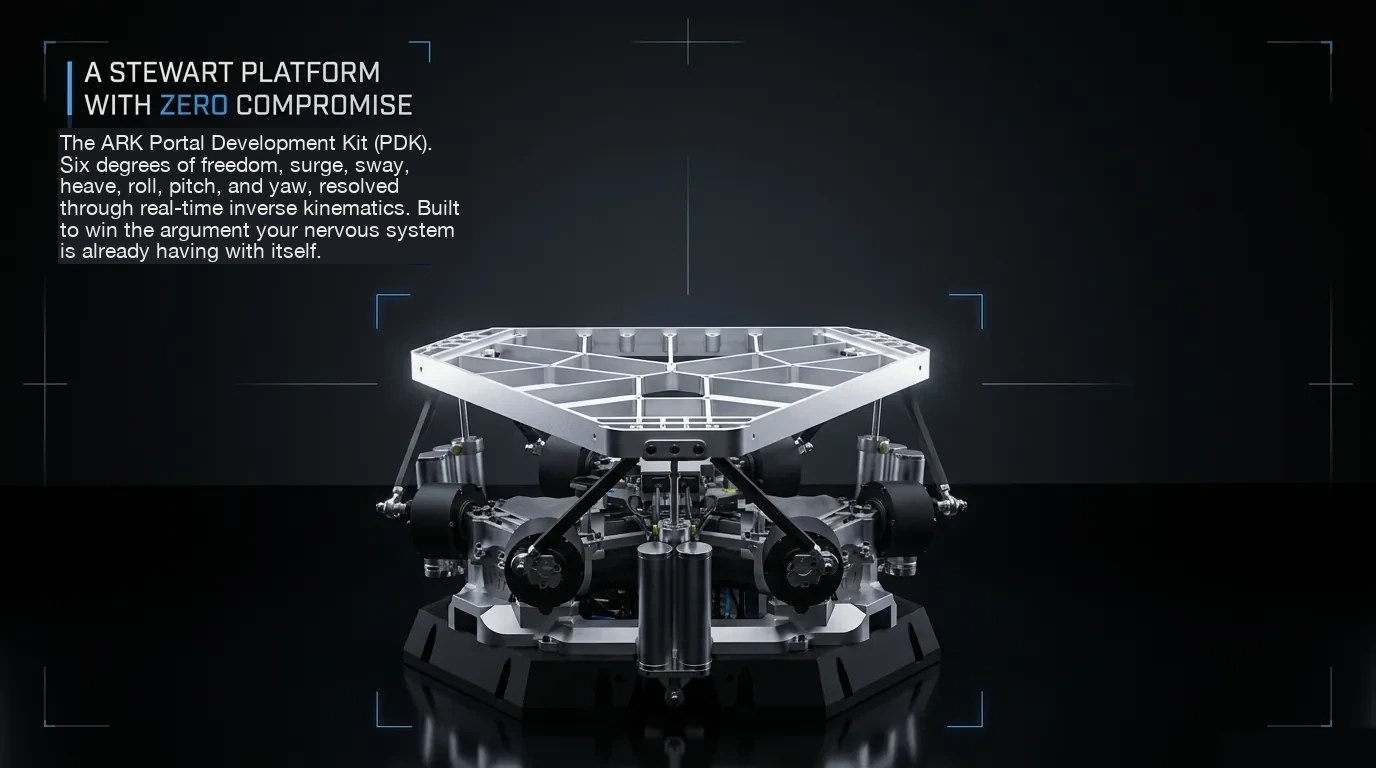
Stack six axes in series and each one carries everything above it — errors add, mass compounds, and the last axis is doing the least useful work. A Stewart platform puts all six legs in parallel between a fixed base and a moving frame, so every leg shares every load and the pose is the solution of all six at once.
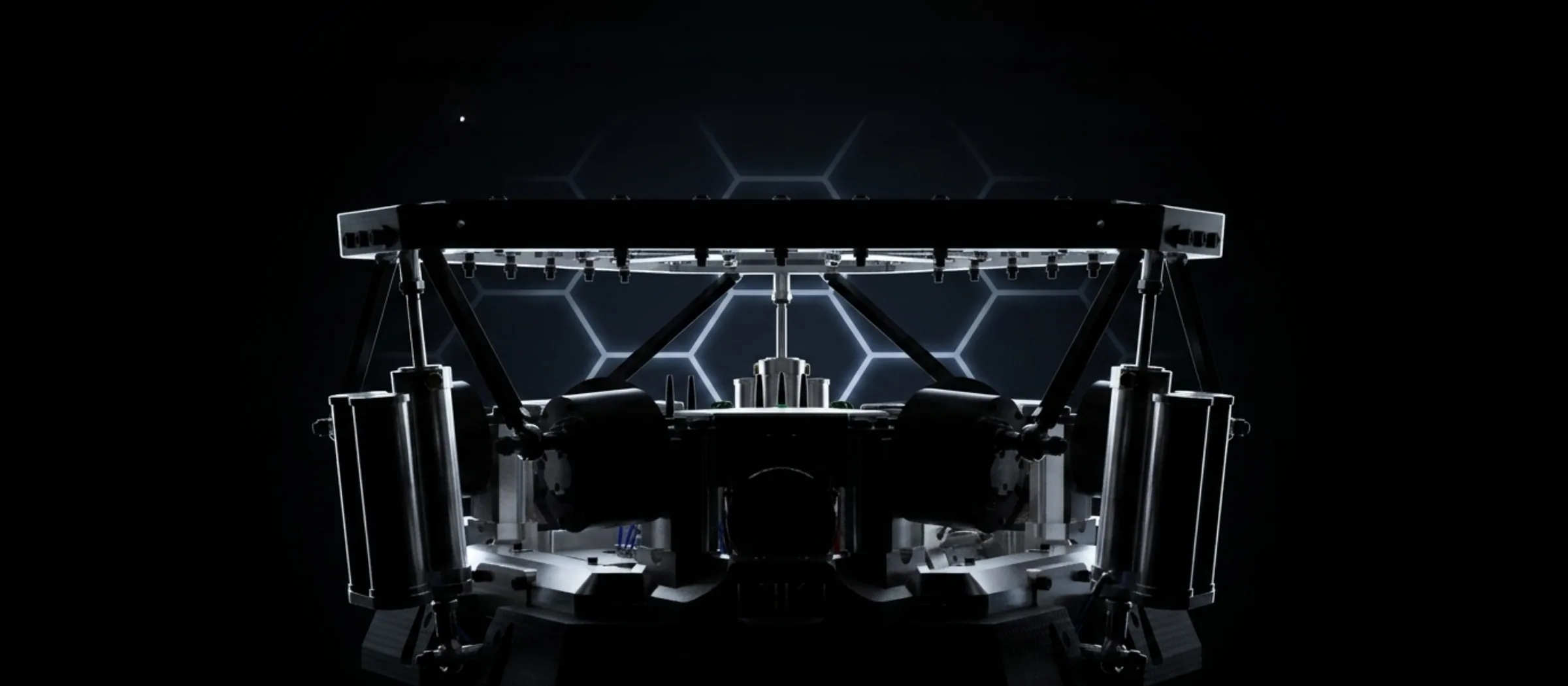
Parallel, not stacked
In a serial machine the axes are a chain, and a chain is as stiff as its weakest link and as accurate as the sum of its errors. In a parallel machine the six legs form a closed structure: a force applied at the platform is shared among all of them, and an error in one is resisted by the other five rather than passed along. The result is a machine that is stiff for its mass, which is the property that decides whether a motion cue arrives crisp or soft.
The six axes
Six degrees of freedom is exactly this list and nothing more. Any pose the platform can hold is some combination of these six, and the solver's job is to turn one combination into six leg lengths.
| Axis | Kind | What you feel |
|---|---|---|
| Surge | Translation | Forward and back — acceleration and braking |
| Sway | Translation | Side to side — lateral load in a corner |
| Heave | Translation | Up and down — kerbs, crests, the road surface itself |
| Roll | Rotation | Leaning into or out of a corner |
| Pitch | Rotation | Nose up and down — weight transfer under power and brakes |
| Yaw | Rotation | Rotation about the vertical — the rear stepping out |
Peak acceleration is 3 g, software-limited, and it describes a brief onset rather than a sustained load — no platform of this size holds 3 g, and the cueing stage is built around that. Per-axis travel is published on the technology page as the nominal single-axis envelope, because the axes trade against each other and no axis reaches its single-axis maximum while the others are working.
The boundary
Working out leg lengths from a desired pose is tractable. Working out the pose from six measured leg lengths is the hard direction, and a platform that wants to know where it truly is has to solve it continuously.
A serial machine has independent axis limits. A parallel machine has a single connected volume with curved boundaries, where reaching further in one axis costs you range in another.
Six actuators are rigidly coupled through the platform. They cannot be commanded independently and hope for the best — a disagreement between legs is a force fight, so they are solved together or not at all.
Patent CA 3217174 C covers ARK's enhancements to this architecture. We describe what the patent exists for and link the document; we do not characterise its breadth or its worth on a product page.
Keep reading
What drives the six legs, and what was deliberately left out of the load path.
How a world with unlimited travel is mapped into a platform with a finite envelope.
CA 3217174 C, and what it actually covers.