Portal Development Kit (PDK): this is a development kit. Supplied as a kit of parts to developers, integrators, researchers and B2B partners for evaluation and development, and assembled by the recipient. Not a finished consumer product, not offered for consumer sale; nothing on this site is a safety certification or a performance guarantee.
Portal Development Kit (PDK) · RSCV021 development build PDK Ecosystem.
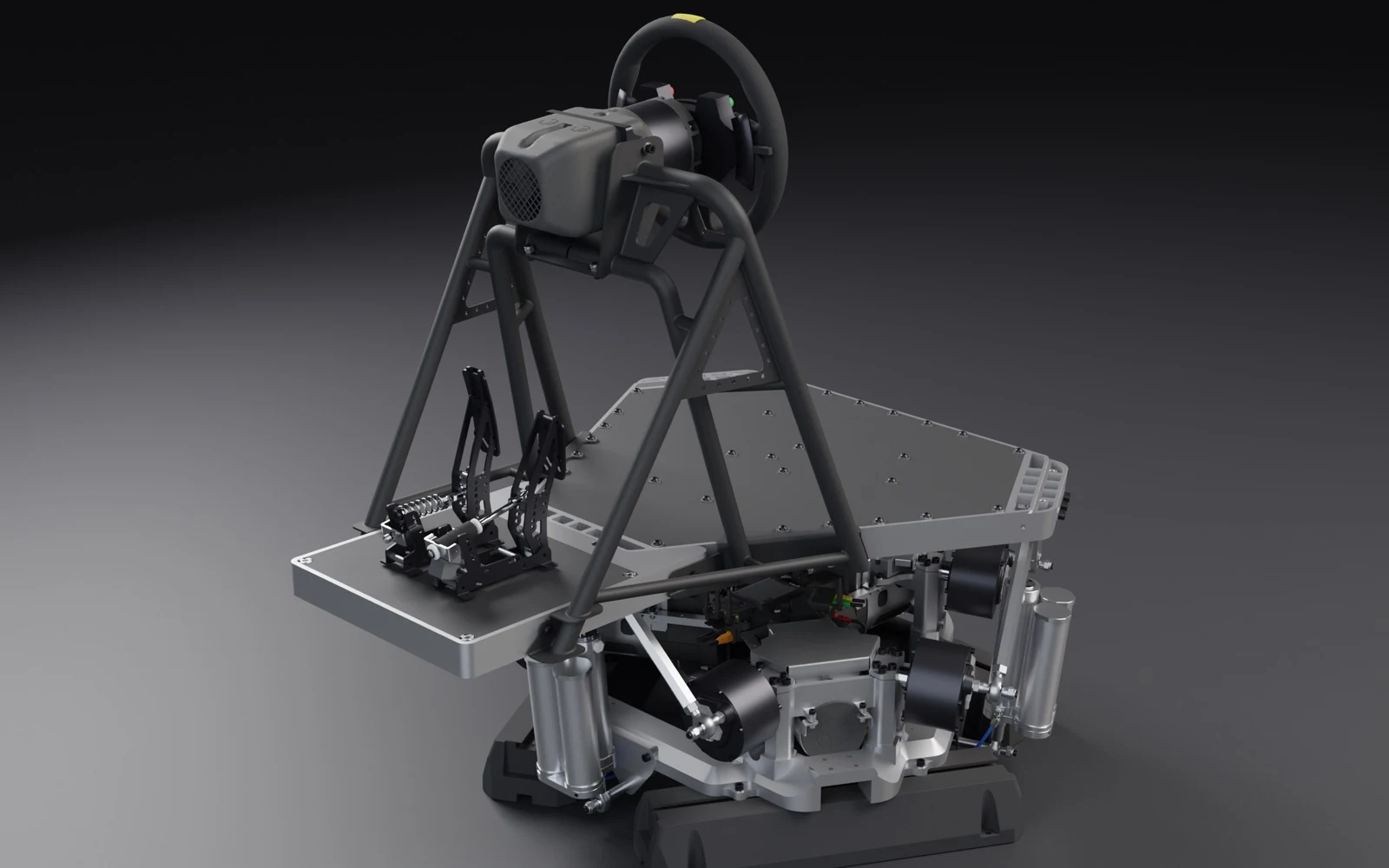
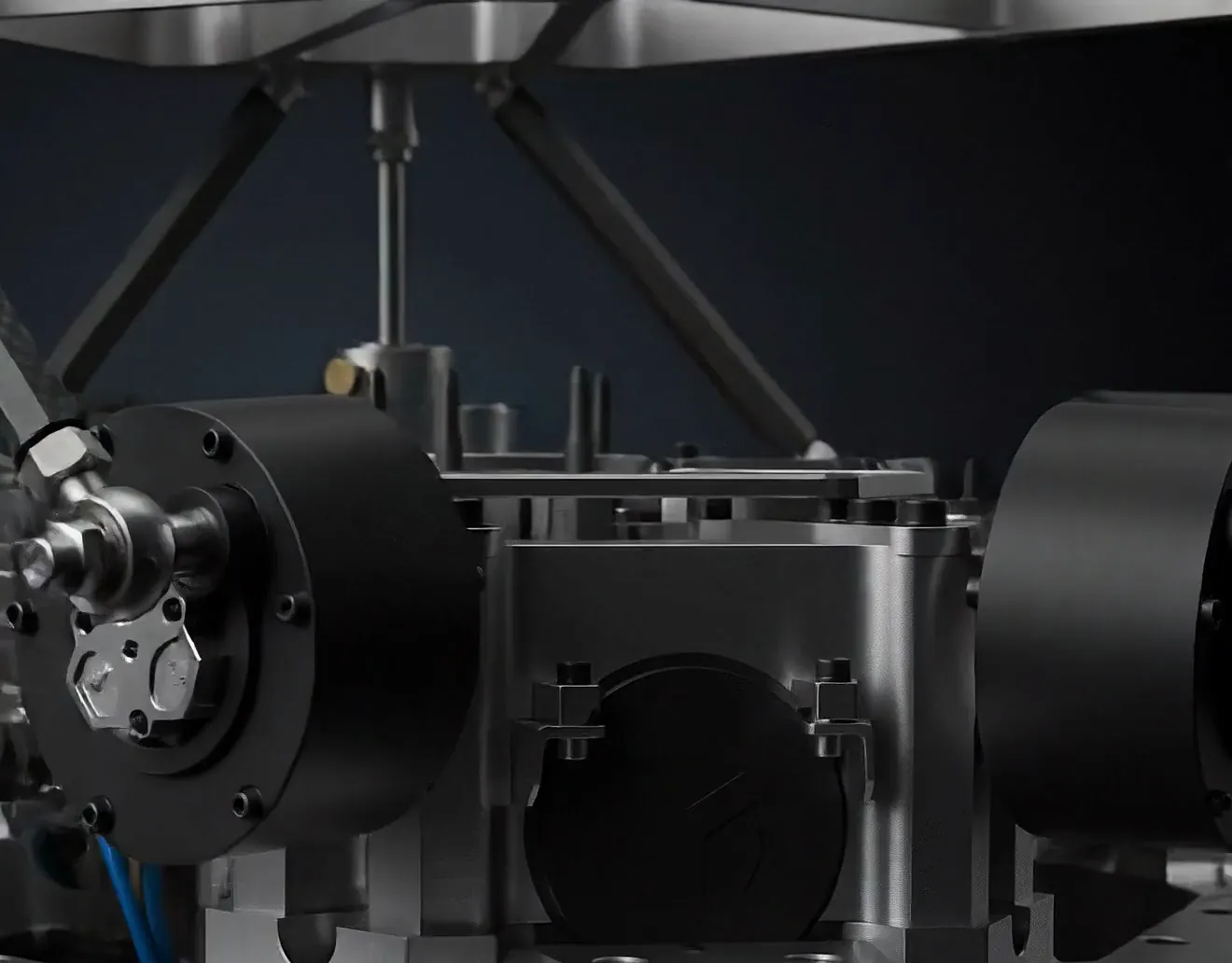
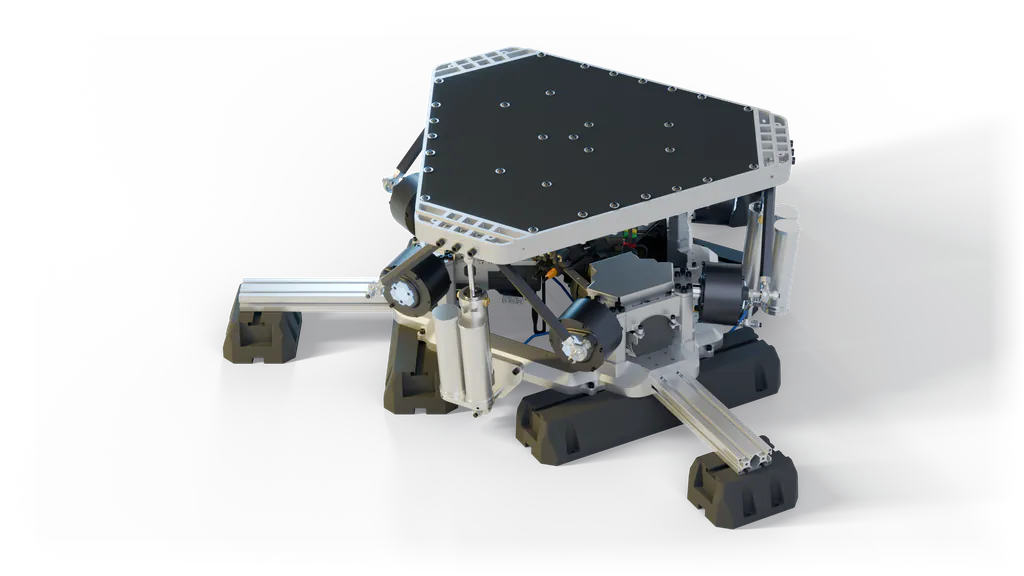
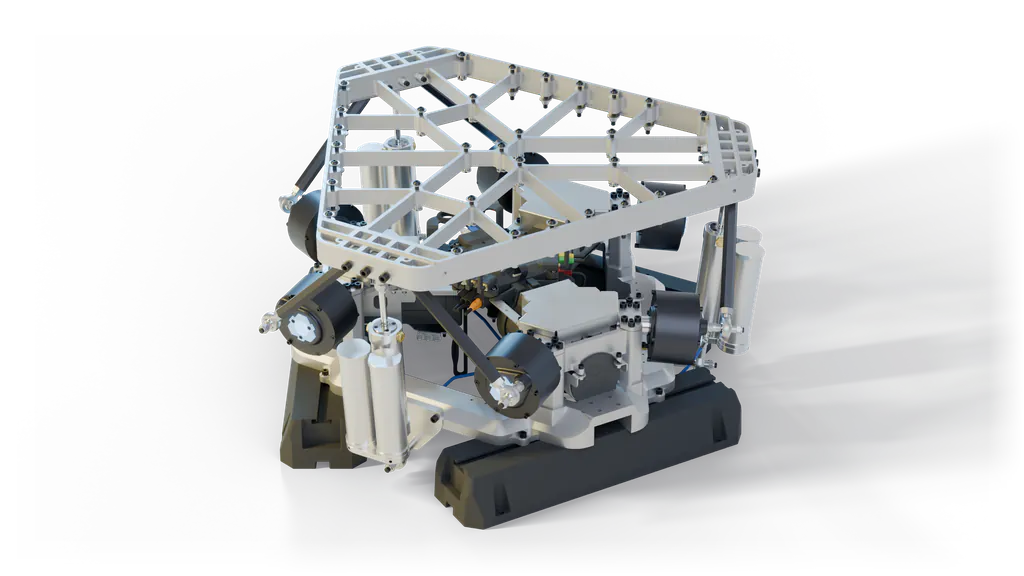
The Portal Development Kit (PDK) is a six-degree-of-freedom (6DOF) development kit for developers, integrators and research partners, built on patented enhancements to the Stewart platform (CA 3217174 C). Three motor blocks, six direct-drive motors and three pneumatic cylinders that carry your weight, so the motors only move you. ARK calls this direct-drive 6DOF (DD6DOF). Under 1 ms and 3 g on all six axes, fully loaded (250 kg). 3 g is the firmware limit on the development kit; the hardware envelope is larger.
Four builds, development-kit price for qualified recipients from $4,899.99 to $8,499.99, or €4,999.99 to €8,699.99.
Development Kit: early-access hardware, software in active development.
One platform. Choose how much of the rig you bring.
The same motion core in every build. The feet and table, the chassis and the ARK peripherals are the difference.
ARK Approved
$8,499.99USD
PDK + ARK Ecosystem
Everything in the render at the top of this page: the PDK, extension feet and wood table, aluminum racing chassis, ARK direct-drive wheelbase, wheel, button box and load-cell pedals. The complete build in one development kit.
Development Kit: early-access hardware, software in active development.
Built to allocation for qualified recipients · estimated 3–6 months from confirmation
RSCV021 chassis build
$6,299.99USD
PDK Racer
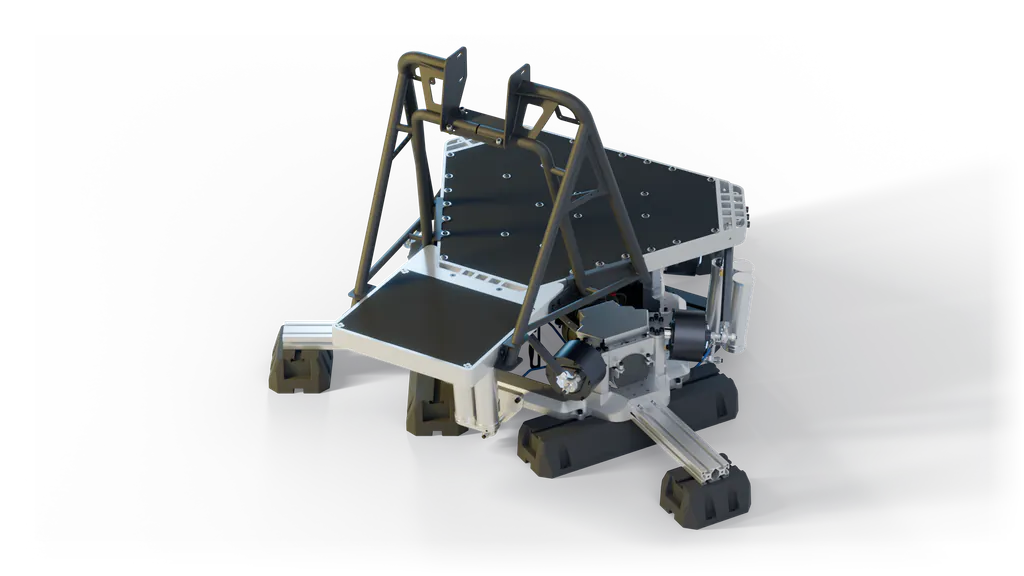
The base build plus the extension feet and table, and the aluminum spaceframe cockpit chassis engineered for the platform's forces: steering-column uprights, center bracket and pedal tray. Bring your own wheelbase, wheel and pedals; the chassis takes Fanatec and Simucube wheelbases and pedals.
Previously listed as PDK + Aluminum Chassis.
Development Kit: early-access hardware, software in active development.
Built to allocation for qualified recipients · estimated 3–6 months from confirmation
RSCV021 free-standing build
$5,299.99USD
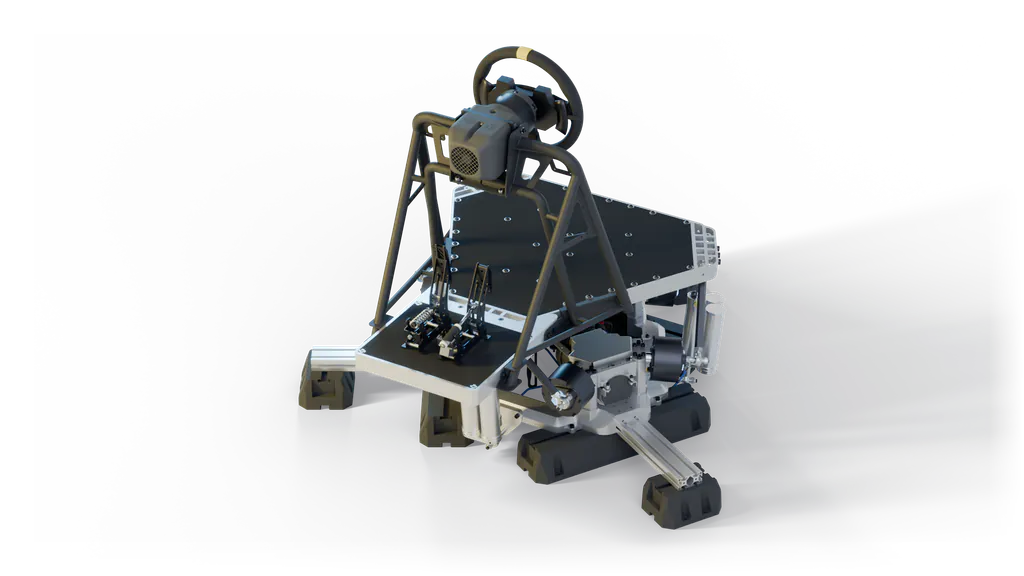
PDK + Extension Feet & Table
The base build on extension feet with the two-piece wood table fitted. Free-standing; the wider feet keep it steady under hard acceleration. On the feet it stands 1.57 m across — three legs at 120°, so plan the space as a circle rather than a rectangle.
The PDK plus the $400 feet-and-table option.
Development Kit: early-access hardware, software in active development.
Built to allocation for qualified recipients · estimated 3–6 months from confirmation
RSCV021 base build
$4,899.99USD
PDK (Portal Development Kit)
The motion core with a flat top. Three motor blocks, six direct-drive motors, three pneumatic cylinders, platform. Bolt it to the floor and mount anything: racing seat, flight cockpit, VR setup, research fixture.
Shipping quoted separately.
Development Kit: early-access hardware, software in active development.
Built to allocation for qualified recipients · estimated 3–6 months from confirmation
Codes
If we have emailed you a personal code, enter it with your development-kit request. One use, tied to your email.
The code applies to three builds — the PDK, the PDK + Extension Feet & Table and the PDK + ARK Ecosystem — at the development-kit prices shown with your request. It does not move the PDK Racer. Prices are fixed on our server — in USD for the United States and the rest of the world, in euros for the EU; shipping is quoted separately.
What ships
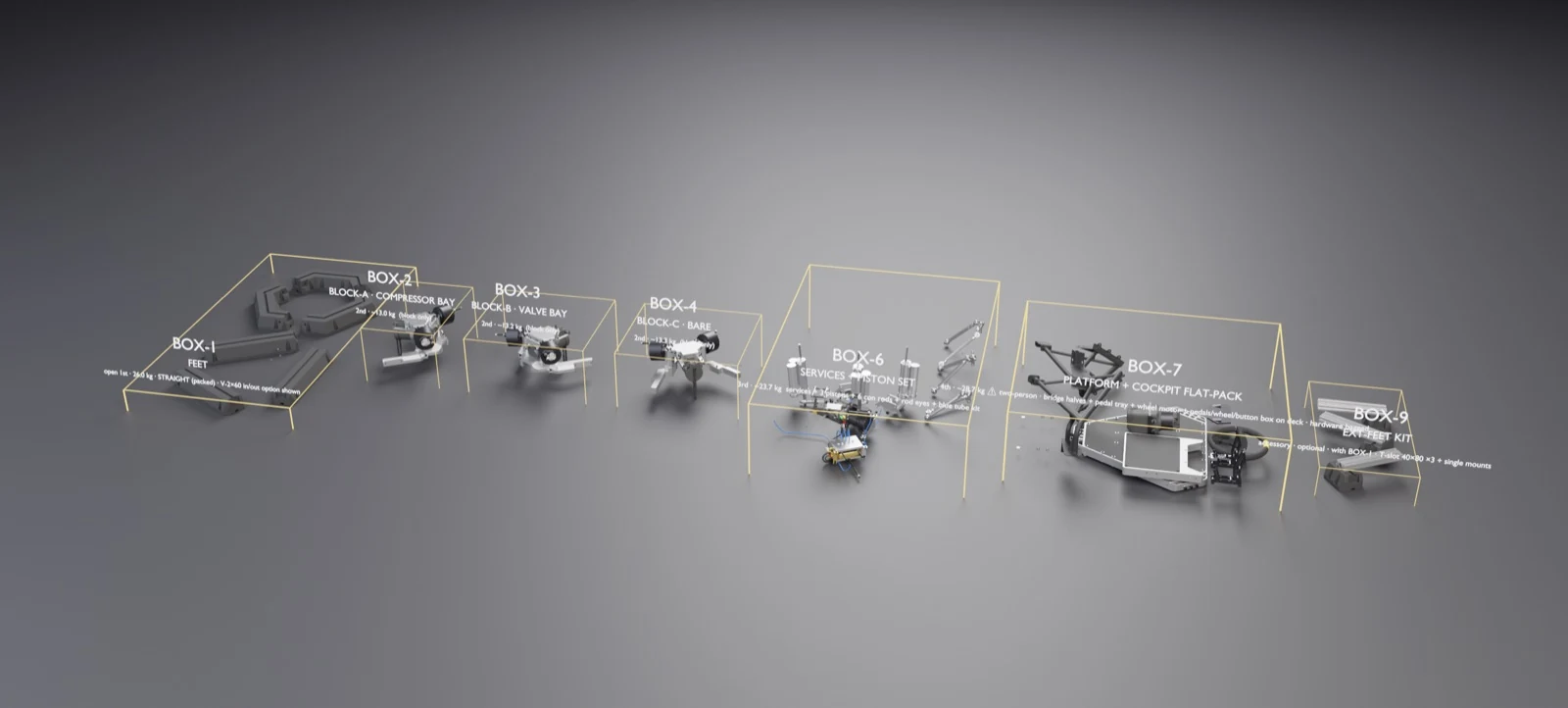
The Ecosystem ships in up to nine boxes. Nothing over 26 kg.
One person can carry every box. Open them by number and the assembly sequence follows.
9
boxes at most (Ecosystem), none over 26 kg
14
steps, feet first
The box plan, measured from the CAD model
Shipping boxes, contents, mass and opening order
Box
Contents
kg
Open
1 · Feet
3 monoblock floor mounts (recycled sintered rubber, aluminum rail channel) + rails. Straight feet ship with every kit; V feet come later
≈26*
1st
2 · Block A
Compressor-bay block: base + motor-mount monoblocks, 2 motors, capacitor, ArkDrive
13.0
2nd
3 · Block B
Valve-bay block, same core
13.2
2nd
4 · Block C
Bare block, same core
13.3
2nd
6 · Services + piston set
Compressor, valve block, center distribution board, router, tanks, blue tube kit, 3 pistons with brackets, 6 con rods with rod eyes
Spaceframe, pedal tray and the two side beams the wheelbase mounts to. Ships with the PDK Racer and Ecosystem builds; ARK's steering motor ships with the Ecosystem only
* CAD-solid mass; the feet monoblocks are thick-walled, so the real box reads lighter. All masses are taken from the CAD model.
Assembly
Feet first.
From the shipping boxes to a complete build, in the order the boxes open.
Assembly sequence
Feet down — three floor mounts at 120°, rails up. On its own feet, drill and bolt each to the ground; on the extension feet it stands without bolting.
Motor blocks onto the feet — blocks bolt to each other and to the feet on rubber isolators.
Compressor placed in its bay on its mount plate.
Valve block placed in the opposite bay.
Blue pneumatic lines — compressor to manifold to cylinders and buffer tanks, push-fit.
Center lower case seated on the rubber mounts at the machine center.
Capacitor power leads through the case slots — the heavy DC bus.
Three power leads bolted to the underside of the distribution board.
Board down and bolted; center covers close it up.
Three ribbon cables from the board to the three ArkDrives.
Con rods onto the table, then table onto the base: rod eyes onto the motor cam axles, pistons pinned.
Pedal tray to the platform front.
Steering uprights, left and right.
Steering assembly as one piece into the center bracket.
Extension feet, when included, bolt to the feet after step 1. Sequence verified against the CAD interfaces.
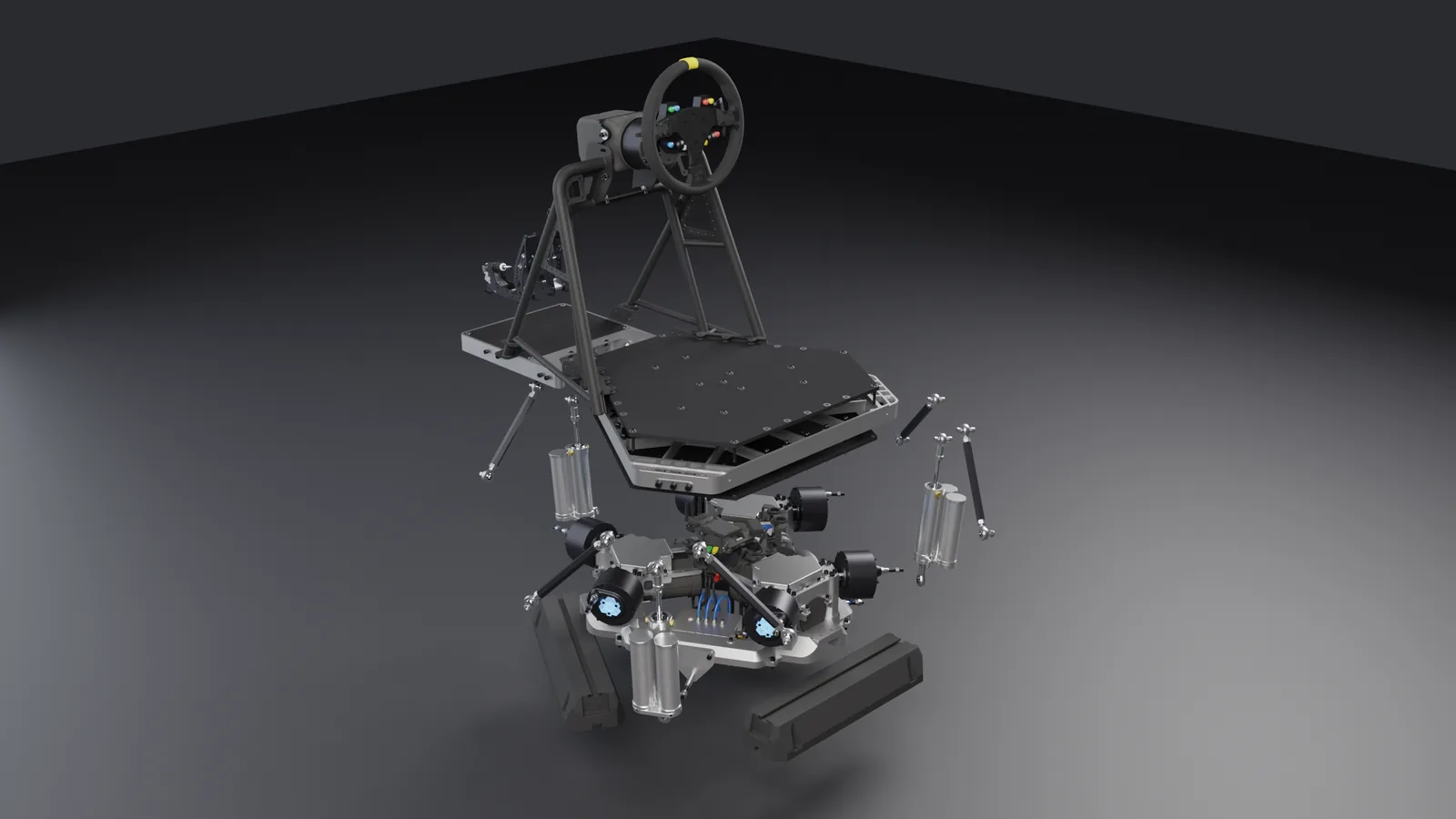
52 seconds from the shipping boxes to the finished build, rendered from the CAD model. Nothing loads until you press play.
Exploded view: cockpit and platform above the motor blocks.
Specifications
System components.
Major hardware, electronics and peripherals of the RSCV021 build, in three tables. Sources for the dotted figures are listed under the tables.
Envelope
How far it moves
Single-axis limits, every other axis at neutral. The axes trade against each other, so no axis reaches its maximum while the others are working.
Motion envelope by axis, with payload and platform mass
Axis
Range
Total span
Surge
−75.49 … +82.74 mm
158.23 mm
Sway
± 71.92 mm
143.85 mm
Heave
± 58.68 mm
117.35 mm
Pitch
−7.98° … +8.09°
16.07°
Roll
± 8.68°
17.36°
Yaw
± 9.80°
19.60°
Payload
—
up to 250 kg
Platform mass
—
115 kg
Envelope read from the T1 firmware boot banner, 7 July 2026 capture. A combined-axis “extended” envelope is larger, and it is published when it is measured. Size a cockpit around every pose the platform can reach, and leave clearance beyond these figures. The envelope in full ›
Subsystem 01
Motion control
Six direct-drive motors in three identical blocks, three dual-axis drives, one bus. Nothing between a motor and the platform it moves.
Motion control subsystem: component and specification
Component
Specification
Servomotors
6 × direct-drive outrunners in 3 blocks · 132 mm · 53.3 V · Kv 13.5
Motor build
Cast-aluminum bell on a steel drum, 30 magnet bars, SKF bearings, 21-bit encoder on a flex PCB
Position sensing
21-bit magnetic encoders · 0.000171661° per count
Motor controllers
3 × ArkDrive dual-axis · 53.3 V · 56 A per motor channel to the ArkDrive · field-oriented control
Distribution
ArkDrives plug directly into the center distribution board (ribbon interconnect)
Buses
SPI to encoders · CAN bus for system communication
Subsystem 02
Weight compensation (patented)
Air carries the static load, so the motors spend their budget on motion instead of holding you up. This is the part the patent covers.
Weight compensation system: component and specification
Component
Specification
Pneumatic cylinders
3 × 50 mm bore · 140 mm stroke, with ballast tanks
Operating pressure
6.0 bar maximum
Valve block
10-station manifold
Compressor
Integrated HC210B on rubber mounts
Control
Automatic load monitoring and adjustment
Subsystem 03
Power and control electronics
One universal supply, a capacitor bank sized for the bursts, two controllers. Every loop quoted here runs inside the platform.
Power and control electronics: component and specification
Component
Specification
Power supply
100–290 V AC · 3,000 W on 200–290 V, 1,400 W on 100–130 V
Capacitor bank
3 × 0.47 F · 63 V on a 25 mm² DC bus · >30 kW burst
Static hold power
15 W
Primary controllers
2 × ARM Cortex-M7 @ 600 MHz — Housekeeper (HKP) and Motion Cueing Processor (MCP)
Control loops
game to motion 1 kHz · control loop 3.3 kHz · 8 kHz drive loop per motor
Presence sensing and stop
2 × mmWave presence radars standard · up to 6 for 360° coverage · emergency stop (development-kit feature; not a certification)
Networking
Ethernet to the PC · onboard Wi-Fi router and Ethernet switch, serving the tuning dashboard
How we know this
CAD-measured items come from the RSCV021 model inventory (297 parts, 1,847 placed solids), read directly from the design files.
Capacitor value: 0.47 F / 63 V per the electrical bill of materials and the designer's own specification; the CAD part label "0.5 F" is the vendor's nominal name.
Loop rates are control loops, not a telemetry rate to a game or PC.
Straight feet, the extension feet, and the covers and trays that ship.
Configuration 01
Feet
Straight feet ship with every kit. V-in and V-out feet come later.
Straight — the standard footprint
V-in — V-feet pointing inward
V-out — V-feet pointing outward, ≈80 mm further out per station on the same bolts
Motion envelope is identical across all three
Configuration 02
Extension feet
An accessory, shipped as its own box.
Three T-slot arms with sliding nuts and single floor mounts
Makes the platform free-standing for labs, studios and shows
Stacks on any foot style
Development-kit price:+$400 with the wood table on the bare PDK; included with every kit above it
Configuration 03
Covers and trays
What closes the platform and where the pedals sit.
Platform covers: plywood 10 mm ships
Pedal tray at the front; the table is three-fold symmetric, so up to three tray positions are possible
On the extension feet it stands without bolting; for a fixed installation, bolt the feet to the floor
Software
Drive it with FlyPT Mover, or with your own code.
FlyPT Mover is a free, independent motion-cueing tool with a large library of supported games. The PDK integrates with it out of the box. The list of supported titles is FlyPT Mover's, not ours, and grows on their schedule.
Developers can stream six-dimensional pose commands directly to the platform over the network and build motion experiences no game has shipped yet.
Holds you up with air, so the motors only move you
Request a development kit
PDK Ecosystem
$8,499.99
USD · development-kit price
Development-kit price for qualified recipients. Support, cancellation and import terms are in the Development Kit Evaluation Agreement. Shipping is quoted separately when your development kit is ready. Codes apply with your request.
What applies — support, cancellation and import terms are in the Development Kit Evaluation Agreement. The PDK is a development kit for evaluation and development, assembled by the recipient.
Where we supply today — the United States and the rest of the world, except a few places we cannot ship to (listed with the request). In the UK, the Channel Islands, the Isle of Man, Gibraltar, Norway, Iceland, Switzerland, Liechtenstein, Canada, the French overseas departments, Saint-Martin and the Åland Islands we supply businesses only: you give your company, its VAT or registration number and a business delivery address when you request. New EU requests are paused and will reopen for businesses only.
Who supplies it — to the United States and the rest of the world: ARK Dynamics Global, a Wyoming corporation, in USD. To the EU: ARKINEMATICS LIMITED, a Cyprus company, in euros. ARKINEMATICS is also our EU data-protection representative.
When it is ready — built to allocation for qualified recipients, estimated 3–6 months from confirmation; delays of up to 12 months beyond that are possible.
The paperwork — the Development Kit Evaluation Agreement, with the Terms and the Shipping Policy.
Request through the configurator: pick the build, add a code if you have one, and send your development-kit request. Development-kit prices are fixed on our server, in USD for the United States and the rest of the world; shipping is quoted separately when your development kit is ready.
FAQ
Before you request a development kit.
Do I need to assemble it?
Yes, from pre-assembled modules, feet first. Every box is under 26 kg, so one person can do it. The Safety Manual and Installation Guide ship with the kit; the Kinemaniacs community site, where developers will share build notes and tuning profiles, is in development. The PDK is a development kit assembled by the recipient; it is not a finished machine until assembled and commissioned.
What is the difference between the four builds?
Four builds share one motion core. The PDK is the core with a flat top — mount your own seat or rig. PDK + Extension Feet & Table adds the wider feet and a desk-height table top. PDK Racer adds the aluminum cockpit spaceframe. PDK + ARK Ecosystem adds the ARK direct-drive wheelbase, wheel, button box and pedals: the complete build in one development kit.
How do the codes work?
A personal, single-use code, sent by email, lowers the development-kit price of the PDK + ARK Ecosystem, the PDK + Extension Feet & Table or the PDK. It does not move the PDK Racer.
Which games work?
Any title supported by FlyPT Mover, which is free to use. FlyPT Mover maintains that list. You can also drive the platform from your own software.
What does the patent cover?
Enhancements to the Stewart platform architecture including the passive load-compensation system: patent CA 3217174 C, granted 11 February 2025. See Patents.
Where do the numbers come from?
Every figure on this page is tracked to its source: the RSCV021 CAD model, a primary document, or ARK's published specification.