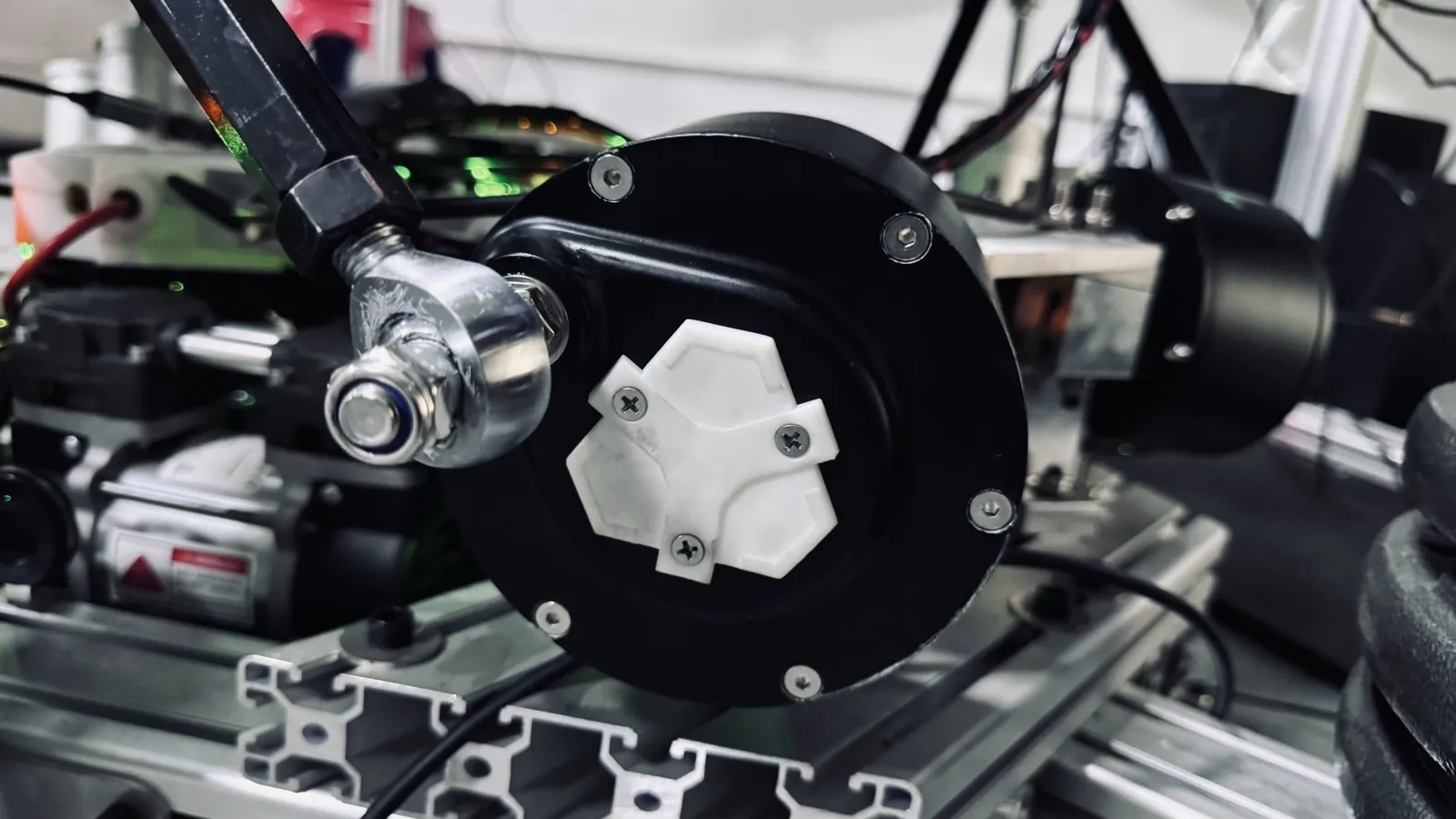
The motor gets larger
Direct drive is why the PDK uses six large-diameter, high-pole-count motors rather than six small ones behind reducers. Torque comes from radius and magnets, not from gearing.
Engineering · Architecture
A transmission is a machine for trading precision against torque. The PDK does not make that trade. Each leg is driven straight off the motor shaft — no gearbox, no belt, no ballscrew, no coupling to wind up and give back.
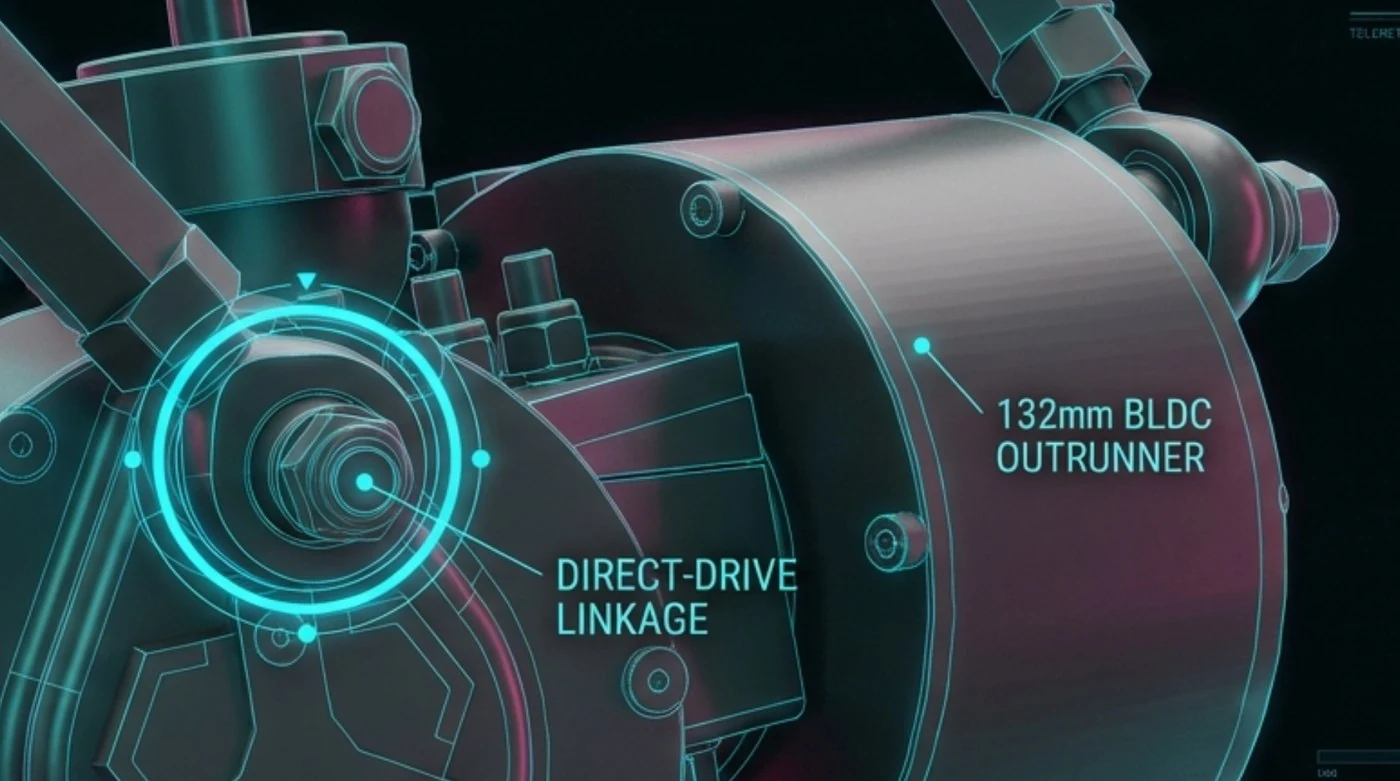
What it removes
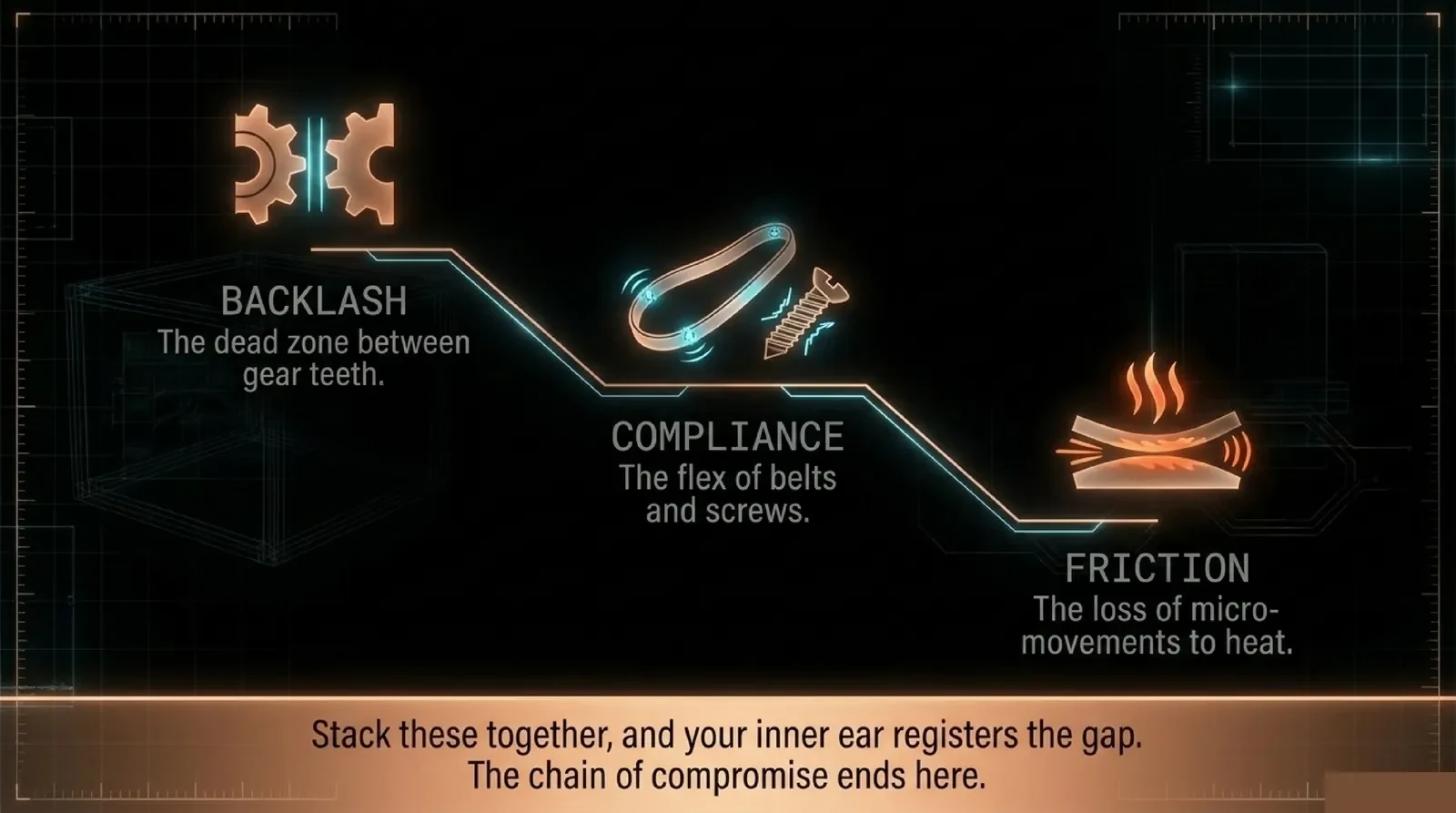
Gear teeth have clearance, or they seize. Belts stretch under load and recover late. Ballscrews have a reversal band you can measure. None of these are defects — they are what those parts are. They only become a problem when the thing you are building is a machine whose whole job is to put a platform exactly where the solver said, and to do it again on the way back.
The boundary
A reduction stage multiplies torque. Take it away and the motor has to produce, at the shaft, all the torque the platform needs — and hold it while standing still, which is the case a motor likes least.
Direct drive is why the PDK uses six large-diameter, high-pole-count motors rather than six small ones behind reducers. Torque comes from radius and magnets, not from gearing.
A worm drive holds a static load with no power at all. A direct-drive axis holds it with current, and current is heat. Standing still is a thermal case, not a rest state.
So it does not sit on the motors. Pneumatic cylinders carry the static mass and leave the motors free to do the part only they can do — move it. That is the subject of its own page.
Patent CA 3217174 C covers the enhancements to the Stewart architecture that make this arrangement work. The patent is a fact; what it is worth is a judgement, and we do not make one here.
What replaces it
With nothing mechanical between command and load, the loop rate is the stiffness. These are the rates the platform actually runs at. Every one is internal to the machine — none of them is a promise about what your PC or your game will see.
| Stage | Rate | What it does |
|---|---|---|
| Game telemetry | the title's own | Typically 60 Hz. Not ours, and not something we can raise. |
| Washout DSP | 20 kHz | Filters the game signal into a motion cue the platform can actually execute. |
| Position commands | 1 kHz | Pose sent to the housekeeper, and on to each drive over CAN at 2 Mbaud. |
| Inverse kinematics | 3.3 kHz | One pose resolved into six leg targets. |
| Drive loop, per motor | 8 kHz | 125 µs. Current and position closed on the encoder every single cycle. |
Keep reading
The specific defect direct drive exists to remove, and how it shows up in a motion platform rather than a machine tool.
Direct drive only pays off if you can measure the shaft finely enough to control it. This is the sensor that makes it possible.
What you actually receive, what it costs, and what you assemble yourself.