FAQ · Portal Development Kit
Questions,
answered.
What the Portal Development Kit (PDK) is, how a development kit is supplied and where every number comes from.
Development Kit: early-access hardware, software in active development.
Contents
Where an answer carries a figure, the figure carries its source, and a dotted underline marks it.
01 · The kit
The kit
What arrives, what it takes to build, and what it runs.
Who is the PDK for?
Developers, integrators and research partners who build on a development kit. The Portal Development Kit (PDK) is supplied as a kit of parts for evaluation and development, and the recipient assembles and commissions it.
How much room and power does it need?
The PDK (Portal Development Kit) needs 1.00 × 1.00 m of floor on its own feet, or a circle 1.57 m across on its extension feet, and an earthed wall outlet: 3,000 W on 200–290 V mains, 1,400 W on a 100–130 V outlet such as a US one. No compressed-air line; the compressor is built in. It can stand on its extension feet without bolting, or you bolt the feet to the floor for a fixed installation. Room and power in detail: how much room and power a motion platform needs.
What is the difference between the four builds?
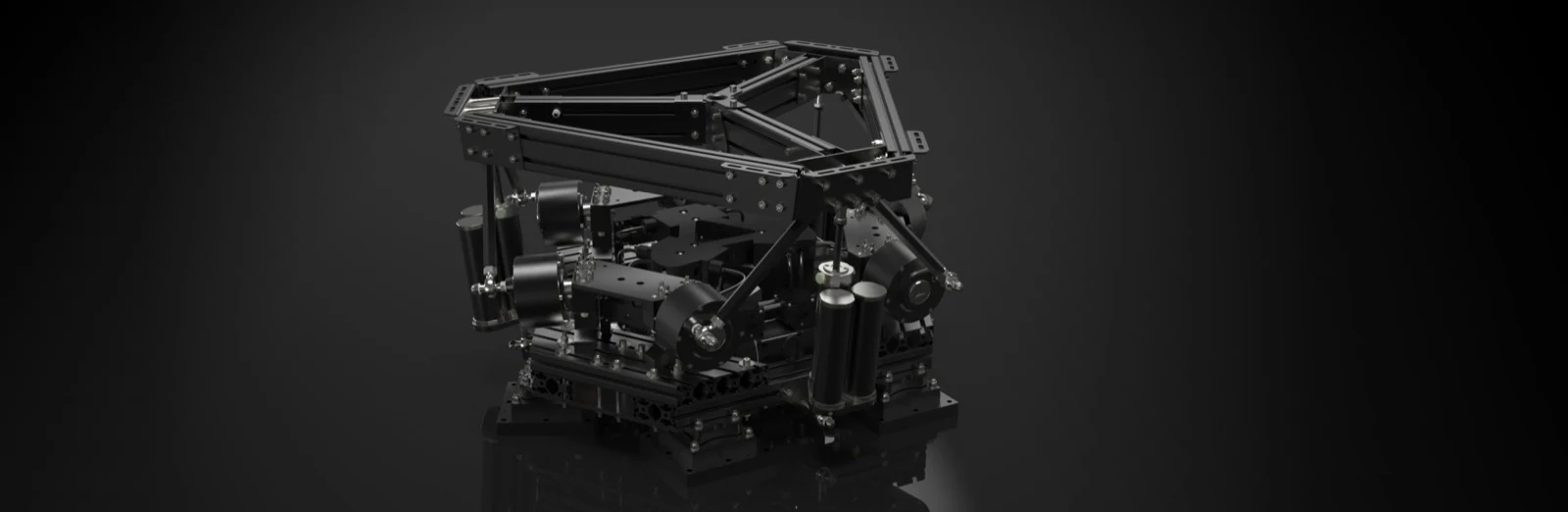
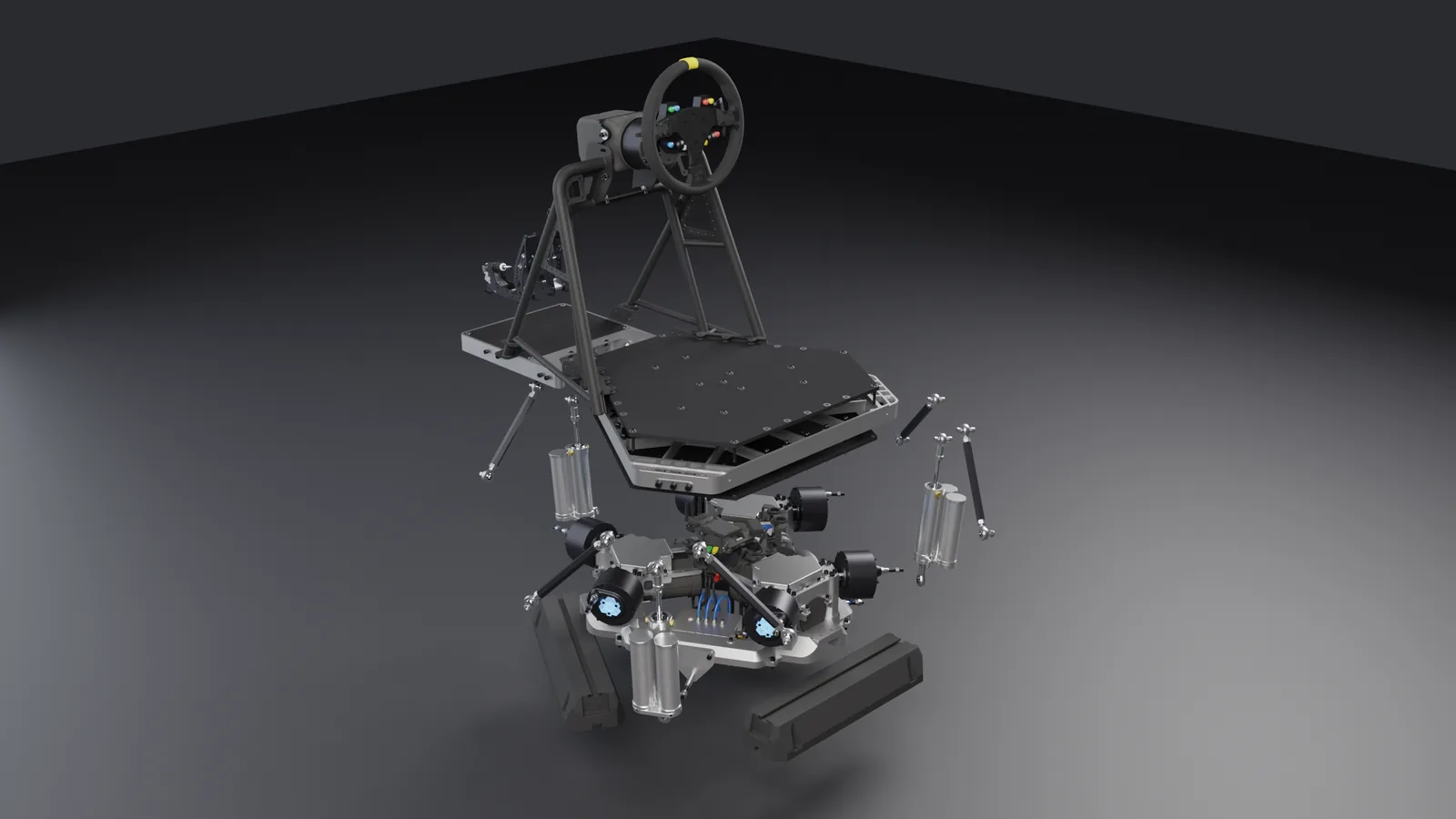
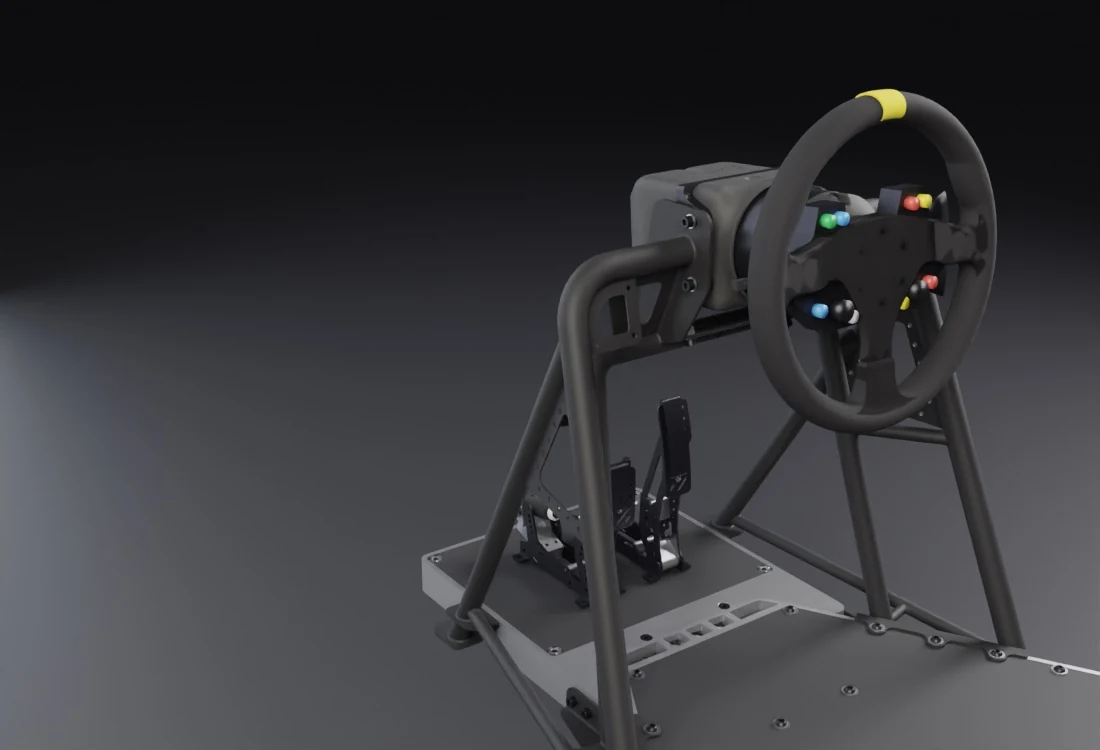
Four builds share one motion core. The PDK is the core with a flat top — mount your own seat or rig. PDK + Extension Feet & Table adds the extension feet and the two-piece wood table. PDK Racer adds the aluminum racing chassis, stabilizer feet and pedal tray. PDK + ARK Ecosystem adds the ARK direct-drive wheelbase, wheel, button box and pedals: the complete build in one development kit.
Will my seat or rig fit?
Yes. The flat top ships with a 10 mm plywood cover. Your seat mounts directly on the table: drill the wood top, or bolt through the holes in its aluminum skeleton. A rig or cockpit mounts the same way.
Which seat do I need?
A seat rated for motion use (Safety, 7.3). No build includes one. It mounts directly on the top: drill the wood top, or bolt through the holes in its aluminum skeleton. Our full-rig cost page counts a racing seat at $399.
Can I fly with my stick, throttle and rudder pedals?
Yes. The two-piece wood table gives you a lot of room to mount flight hardware. Rudder pedals work: we use them ourselves.
Do I need to assemble it?
Yes. The recipient assembles it: the kit arrives as pre-assembled modules in six to nine boxes depending on the build, none over 26 kg, and bolts together feet first. The Safety Manual and Installation Guide ship with the kit; the Kinemaniacs community site, where recipients will share build notes and tuning profiles, is in development.
Which games work?
FlyPT Mover and SimHub integration, with 80+ games supported locally. FlyPT Mover is a free third-party tool that turns game telemetry into platform motion, and it keeps its own list of titles. You can also drive the platform from your own code.
Does it work with Xbox and PlayStation?
Yes. The PDK works with Xbox and PlayStation too.
Does VR work on a moving platform?
Yes. Motion compensation works on the PDK, so the view in your headset stays steady while the platform moves.
Is it maglev?
Yes. Maglev is our name for the technology that makes the platform feel weightless: per-axis friction and gravity compensation maps in the drive firmware, measured on the wheel at 0.00435 N·m against a 0.005 N·m pass mark. They ride on pneumatic compensators and direct-drive motors. The air carries the mass, the motors move it, and the maglev maps make it feel frictionless.
What does the patent cover?
Adjustments to the Stewart platform that separate weight-bearing from positioning: a pneumatic actuator carries the load and a direct-drive actuator does the moving. It is patented technology, granted 11 February 2025.
Can I use it commercially?
The PDK is supplied for evaluation and development under the Development Kit Evaluation Agreement. Commercial operation — a venue, an attraction, paid rides — needs a separate Commercial Operator Agreement; institutional use needs a separate academic license. Write to us with what you are planning.
02 · Supply
Supply
How a kit is supplied, development-kit prices, codes, delivery and who supplies your kit.
Built to order · ready to ship an estimated 3–6 months from confirmation; delays of up to 12 months are possible
How is a kit supplied?
Under an evaluation agreement, invoiced to the recipient. Kits delivered to the United States and the rest of the world are invoiced in USD; kits delivered to the EU are invoiced in euros, from their own published table.
What is the development-kit price?
| Kit | USD | EUR |
|---|---|---|
| PDK + ARK Ecosystem | 8,499.99 | 8,699.99 |
| PDK Racer | 6,299.99 | 6,499.99 |
| PDK + Extension Feet & Table | 5,299.99 | 5,499.99 |
| PDK | 4,899.99 | 4,999.99 |
Development-kit prices, qualified recipients. Prices do not include VAT, import duty, tariffs or taxes. US sales tax is added where we must collect it. EU prices are in euros. Everywhere else, import VAT, duty and customs fees are payable to customs or the carrier on delivery and are not included in the price; we cannot calculate them in advance. For the UK, Switzerland, Norway, Iceland and Liechtenstein, the import VAT rate is shown on the order page. Shipping is quoted and billed separately when your kit is ready. Codes apply on the order page. Support, cancellation and import terms are in the Development Kit Evaluation Agreement.
Can I upgrade my PDK to PDK + ARK Ecosystem later?
Yes. Sign in to your account, open your development-kit order and choose Upgrade to PDK + ARK Ecosystem. You pay the difference between the two builds to the company that supplied your PDK. Before your PDK ships, your order simply becomes the Ecosystem build; once it has shipped, the new parts follow on their own, to the same address.
How do the codes work?
A personal code applies to three builds: the PDK + ARK Ecosystem, the PDK + Extension Feet & Table and the PDK. It does not move the PDK Racer. The code is single-use and tied to your email address; enter it on the order page.
When does it ship?
Built to order · ready to ship an estimated 3–6 months from confirmation. Delays of up to 12 months beyond that are possible. Support, cancellation and import terms are in the Development Kit Evaluation Agreement.
What does shipping cost?
Shipping is not included. It is billed separately when your unit is ready and quoted by destination. We ship to the United States and most other countries; Russia, Belarus, Afghanistan, Venezuela, Cuba, Iran, North Korea, Syria, Crimea, Sevastopol and the Donetsk, Luhansk, Zaporizhzhia and Kherson regions are excluded. EU businesses request development kits by email to devsupport@ark-dynamics.com; each request is reviewed. In Canada we do not deliver to Quebec or British Columbia.
Are taxes included?
Prices do not include VAT, import duty, tariffs or taxes. US sales tax is added where we must collect it. EU prices are in euros. Everywhere else, import VAT, duty and customs fees are payable to customs or the carrier on delivery and are not included in the price. We cannot calculate them in advance: they depend on your country's rates and on your customs authority. For the UK, Switzerland, Norway, Iceland and Liechtenstein, the import VAT rate is shown on the order page. Import VAT (Norway 25 %, Iceland 24 %, Switzerland and Liechtenstein 8.1 %, UK 20 %) on the goods and shipping, plus any customs duty and the carrier's fee, is payable by you on delivery. The duty itself depends on how customs classifies the Kit.
Who supplies my kit?
Development kits delivered in the United States and the rest of the world are supplied by ARK Dynamics Global, a Wyoming corporation, and invoiced in USD. Development kits delivered in the EU, except the French overseas departments, Saint-Martin and the Åland Islands, are supplied by ARKINEMATICS LIMITED, a Cyprus company, in euros. ARKINEMATICS is also our EU data-protection representative. Your supplier, your currency and your total are named on your confirmation.
What support comes with a kit?
Support, cancellation and import terms are in the Development Kit Evaluation Agreement.
03 · Numbers
Numbers
Where the figures come from
- The CAD model — measured off the CAD model of the RSCV021.
- Primary sources — firmware, arithmetic and measured drawings.
- ARK's engineering record — the published specification.
How fast and how strong is the PDK?
Under 1 ms and 3 g on all six axes, fully loaded (250 kg). 3 g is the firmware limit on the development kit; the hardware envelope is larger.
Where do the numbers come from?
Every figure on this site is tracked to its source: the RSCV021 CAD model, a primary document, or ARK's published specification. A dotted underline marks a tracked figure.
How loud is the PDK?
Measured 1 m away: 71 dB while racing, 47 dB with the rig switched off. The air compressor (73 dB) runs only when you get on, when you get off, and during activity, when the system measures an imbalance in weight. The motion is fully tunable, so to run it quieter, turn the motor gains down. The one part to watch is the seat you fit.
How big and heavy is it?
Footprint 1.00 × 1.00 m for the PDK on its own feet, 1.57 m in diameter with the extension feet splayed at 120°. Retracted height 0.50 m. Height 1.13 m to the top of the seat tower. Mass 115 kg. Footprint and height are measured from the CAD model; the mass is the designer's stated figure, and the CAD model agrees.
Does it need compressed air or special power?
No external air: an integrated HC210B compressor feeds the pneumatic cylinders that carry the static load. Power comes from a universal 100–290 V AC supply that auto-switches — 3,000 W on 200–290 V mains, 1,400 W on a 100–130 V outlet — backed by a bank of three 0.47 F, 63 V capacitors that recirculate braking energy. The compressor is measured from the CAD model.
Do 1 kHz, 3.3 kHz or 8 kHz mean my game sends telemetry that fast?
No. Your game sends at its own rate, typically 60 Hz. The PDK turns that into motion 1,000 times a second (1 kHz game to motion), and each update has the platform moving in under a millisecond. Inside the platform, the control loop runs at 3.3 kHz and each motor's field-oriented control at 8 kHz. None of these is a telemetry rate to your PC or game.
Which envelope should I design my cockpit around?
Around every pose the platform can reach. The single-axis figures on the technology page are the motion envelope, and combined moves reach further, so leave clearance beyond them.
Why does forward kinematics matter for a simulator?
It lets the controller reason in the rider's coordinates, surge, sway, heave and the three rotations, rather than only in leg lengths. That is the basis for task-space control and for reporting where the platform is.
Is a motion rig with more travel better?
Not on its own. Every rig has to come back to center before the next move, and more travel means a longer trip back. Bigger rigs are slow, and they drag you back to center. The PDK answers the game in under 1 ms and brings you back below what your inner ear can detect, so all you feel is the car. The PDK pairs that speed with 3 g on all six axes, fully loaded (250 kg). The full comparison is on More travel or faster motion.
Still open
Not answered here?
Write to us with a question that is not here, or order a development kit.
Order a development kit Contact
Built to order · ready to ship an estimated 3–6 months from confirmation; delays of up to 12 months are possible