Patents · CA 3217174 C
Air carries
the weight.
Motors do
the moving.
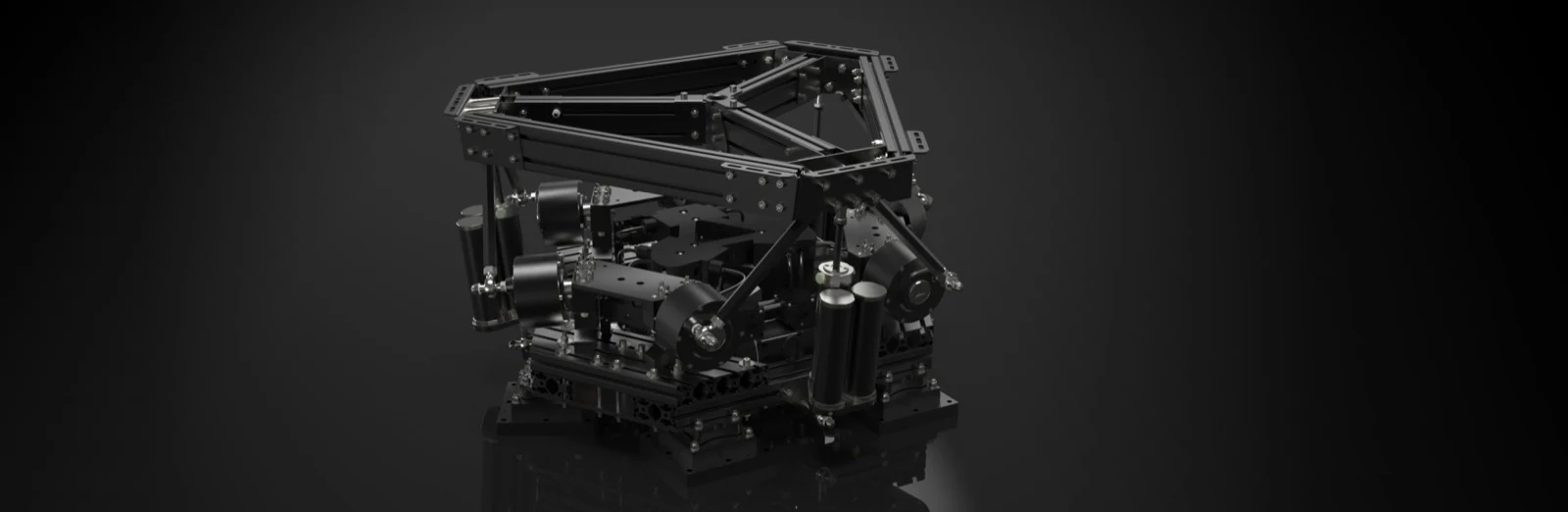
A single idea sits underneath the Portal Development Kit: stop asking the drive motors to hold a person up against gravity. Canadian patent CA 3217174 C covers the system that makes that split work. It is held by Michael Gregoriades, one of the two named inventors, and ARK Dynamics builds under licence from him. It is the only granted patent behind this platform: there is no US or EU grant.
The record
Granted in Canada,
February 2025.
Bibliographic data, read off the Google Patents record and verified on 8 September 2026.
| Patent number | CA 3217174 C |
|---|---|
| Title | Motion Simulation System and Method / Procédé et Système de Simulation de Mouvement |
| Issue date | February 11, 2025 |
| Inventors | Louis Hajichristou and Michael Gregoriades (Cyprus) |
| Proprietor | Michael Gregoriades, applicant and assignee of record. ARK Dynamics builds under licence from him. |
| PCT filing date | February 8, 2023 |
| Priority date | February 9, 2022 (US provisional) |
- Google Patents record CA3217174C — title, inventors, applicant (Michael Gregoriades), priority 2022-02-09, PCT/IB2023/051091, grant 2025-02-11, status Active. verified 2026-09-08 · patents.google.com/patent/CA3217174C/en
- Number, title, dates and inventors above: verified against the Google Patents record. Description and component detail on this page: from the patent text, as published on ark-dynamics.com/patents (captured 2026-09-08). The 1,000 Hz actuator rating and the ranges below are figures from the patent text, not platform measurements.
Read the grant yourself: the full specification, claims and drawings are public at Google Patents, and the official register entry is at the Canadian Intellectual Property Office. ARK does not host a copy of the certificate; both records above are the issuing authority's own.
The innovation
Two jobs, split between two systems.
Most motion platforms ask one set of actuators to do everything: hold the payload up against gravity and move it. The patent describes a system that separates those two jobs.
- Weight-bearing actuators — pneumatic cylinders that carry the static payload weight.
- Positioning actuator assemblies — rotary actuators that control the platform's position.
A controller watches how hard the positioning actuators are working and pressurises the weight-bearing cylinders to take that load off them. The loop is closed with rotary encoders, in either forward or inverse kinematics control modes.
RSCV021, the build sold as the Portal Development Kit, is the first production build of this architecture.
Advantages
What the split buys
Five advantages the patent describes for separating the two jobs.
-
Positioning actuators stop spending their thermal budget standing still.
-
The patent describes operation at frequencies up to 1,000 Hz — a figure claimed in the patent text, not a platform loop rate.
-
Positioning actuators can be smaller and lighter once they are not carrying static weight.
-
The system can regenerate energy during motion.
-
The direct-drive mechanism increases rigidity.
Technical components
Three systems, one machine.
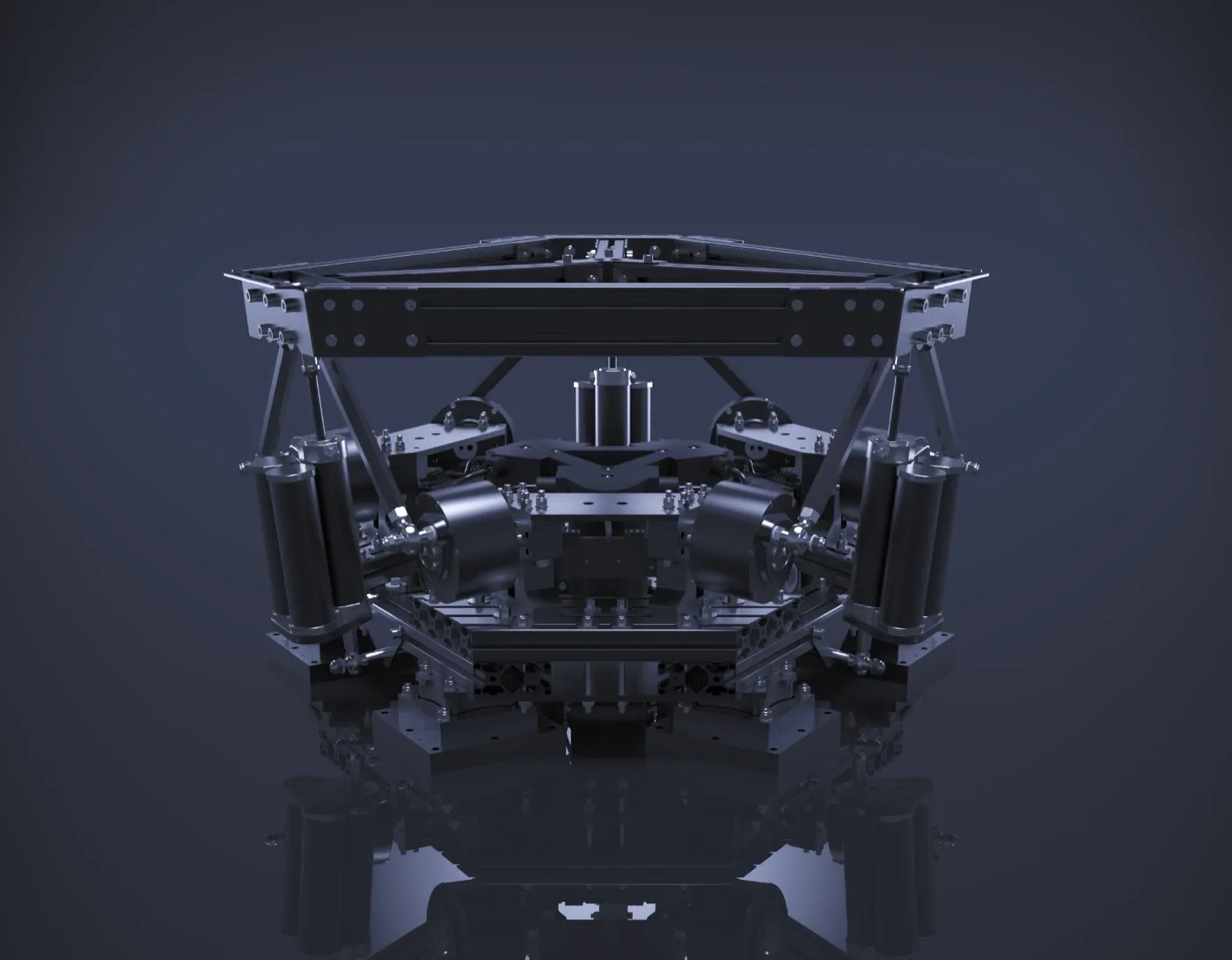
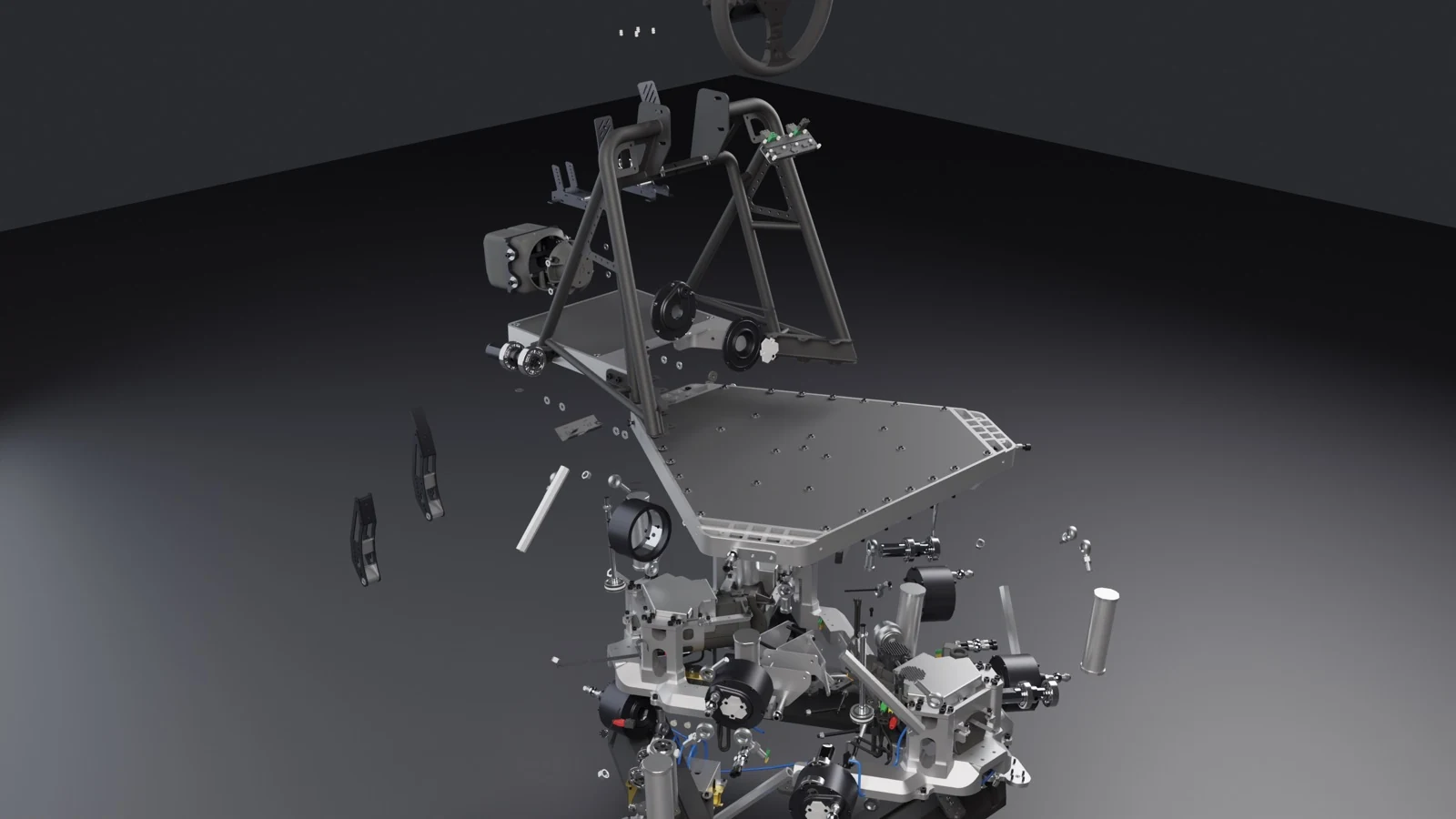
A weight-bearing system, a positioning system and the control system that ties them together. In the render below, the motor blocks and con rods do the positioning; the pneumatic cylinders beside them carry the weight.
System 01
Weight-bearing
Pneumatic cylinders with pistons that create pressurised volumes. Optional buffer tanks add 100–500% additional dead volume, which minimises pressure variation and changes in actuation force. The system can be calibrated to support the platform at a desired position.
System 02
Positioning
Rotary actuators — motors with stators and rotors — driving connecting rods, with optional cranks. The patent describes operation at frequencies up to 1,000 Hz (as claimed in the patent, not a platform loop rate). Six degrees of freedom: surge, sway, heave, roll, pitch and yaw.
System 03
Control
Detects the current drawn by the positioning actuators and pressurises the pneumatic cylinders to minimise their load. Closed-loop control with rotary encoders, in forward and inverse kinematics control modes.
Configurations
What the patent covers, beyond one shape.
The claims describe several arrangements of the two systems, not only the hexapod that RSCV021 builds.
- Three weight-bearing actuators and six positioning assemblies — the standard hexapod arrangement, and the one RSCV021 builds.
- Symmetric and asymmetric layouts — various arrangements of the same two systems.
- Integrated linear actuator units — both functions combined in a single part.
- Haptic-device implementations — for human-machine interfaces.
Ranges described in the claims
These are the ranges described in the patent claims — broader than, and not the same measurement as, the built PDK's measured motion envelope. Do not quote one for the other.
| Parameter | Patent-claimed range |
|---|---|
| Travel limits (some configurations) | −100 mm … +100 mm |
| Angular limits (roll / pitch / yaw) | ±15° … ±20° |
| Ball-joint swivel angles | ±10° … ±20° |
Applications
Where the claims reach.
Fields of use described for the patented system.
Motion simulators
Flight, driving and gaming.
Amusement park attractions
Virtual reality systems
Haptic feedback devices
Low-mass applications
Where no weight-bearing actuators are needed at all.
Canadian Intellectual Property Office
Patent CA 3217174 C
Granted 11 February 2025. Filed under PCT/IB2023/051091. Status Active.
Colophon
References and provenance
- Patent CA 3217174 C, Canadian Intellectual Property Office — bibliographic data and description as published on ark-dynamics.com/patents, captured 2026-09-08. Status: bibliographic data verified at Google Patents (2026-09-08); description from the patent text.
- See Technology for how the built PDK implements this patent, and the PDK Ecosystem for the kit it ships in.