Backlash is the free travel in a mechanism — the distance the input moves before the output notices. Machine tools live with it by never reversing under load. A motion platform reverses under load hundreds of times a minute.
Turn the input back. Count how far it goes before the output moves.
That distance is backlash. It exists wherever two parts transmit force by touching without being rigidly joined: gear teeth need clearance to turn at all, a belt needs slack to run, a ballscrew needs a fit between ball and race. Take the clearance away and the mechanism binds. Leave it in and you have a small region, at every change of direction, where the motor is moving and the load is not.
Why it matters here
A lathe reverses on a tool change. A motion platform reverses constantly.
This is the difference that decides whether backlash is a tolerable specification or a design-defining one. Backlash is a fixed distance, so its importance is set entirely by how often you cross it and how small the motions around it are.
The motions are small
Most of what a rig does under you is not the big heave of a kerb strike. It is the continuous, low-amplitude texture of a surface. Those movements can be smaller than the dead zone itself, which means they do not happen at all — they are absorbed.
The reversals are constant
Six legs, each changing direction independently, many times a second. Every crossing is another pass through the gap. What is a one-off error in a machine tool is a continuous noise floor in a simulator.
It is felt, not seen
You do not perceive backlash as a position error. You perceive it as vagueness — a rig that feels approximately right rather than connected. That is the hardest kind of fault to diagnose from a spec sheet, because no line on the sheet is wrong.
What it costs you
The resolution you paid for, spent on a gap.
Backlash and encoder resolution work against each other directly. A fine encoder tells the controller precisely where the motor shaft is. If there is a transmission after the shaft, none of that precision reaches the platform until the gap is crossed.
Angular resolution of the PDK encoder, and what a transmission would do to it
Quantity
Value
Where it comes from
Encoder word length
21-bit
Absolute magnetic encoder on every motor
Discrete positions per turn
2,097,152
2 to the 21st power
Angular resolution
0.0001716°
360° divided by 2,097,152
Drive loop
8 kHz
The encoder is read every 125 µs cycle, not on a slower timer
Mechanism between shaft and leg
none
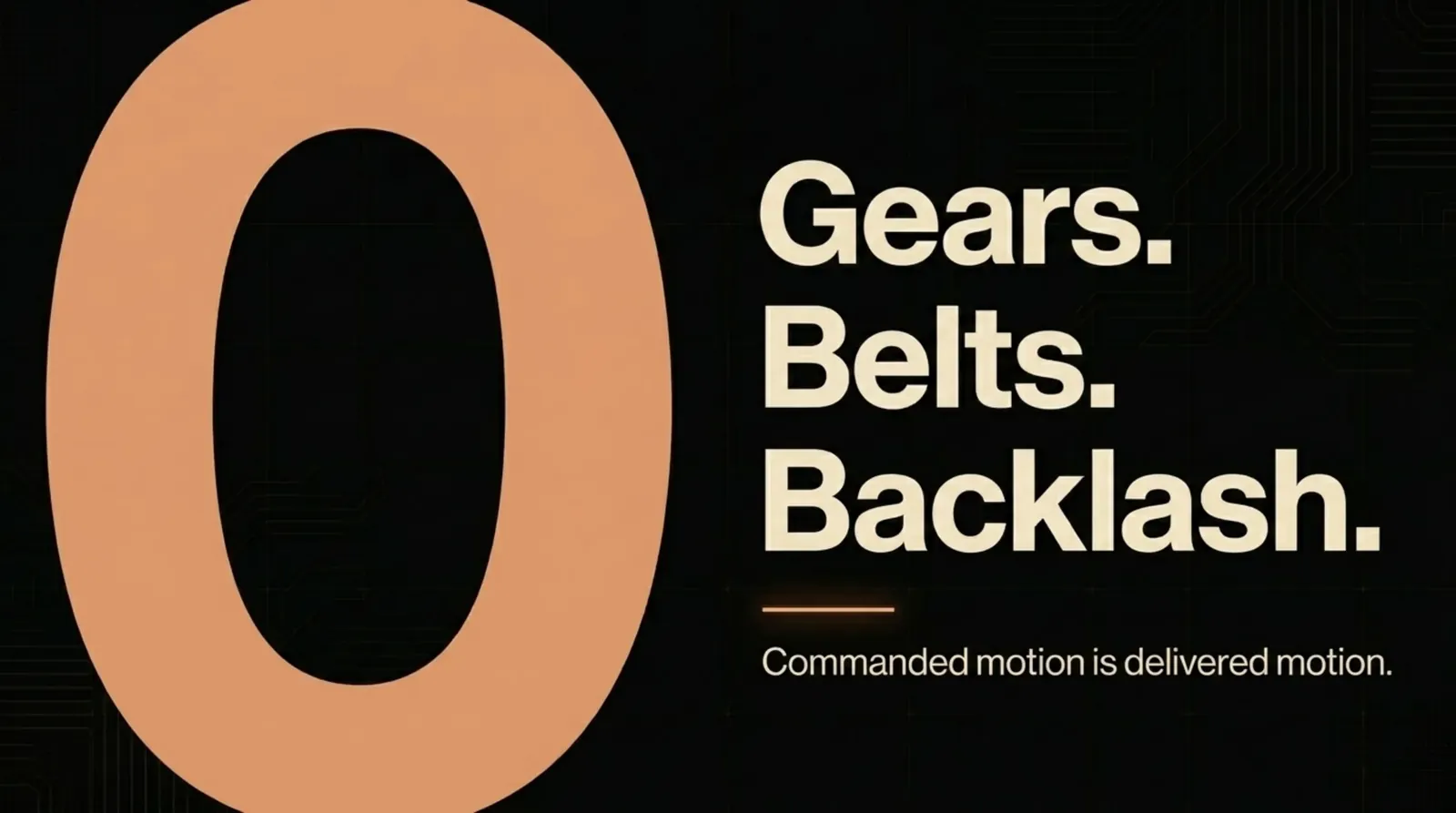
No gearbox, belt, ballscrew or reducer to add a gap
How we know this
21-bit resolution and the division arithmetic claim C10 · arithmetic checked here
Direct-drive architecture, no reduction stage Patent CA 3217174 C · the platform's own construction
We publish no backlash figure for the PDK: the architecture removes the parts that produce it, which can be checked by looking at the machine. A measured figure is published with its rig and method when the measurement is made.
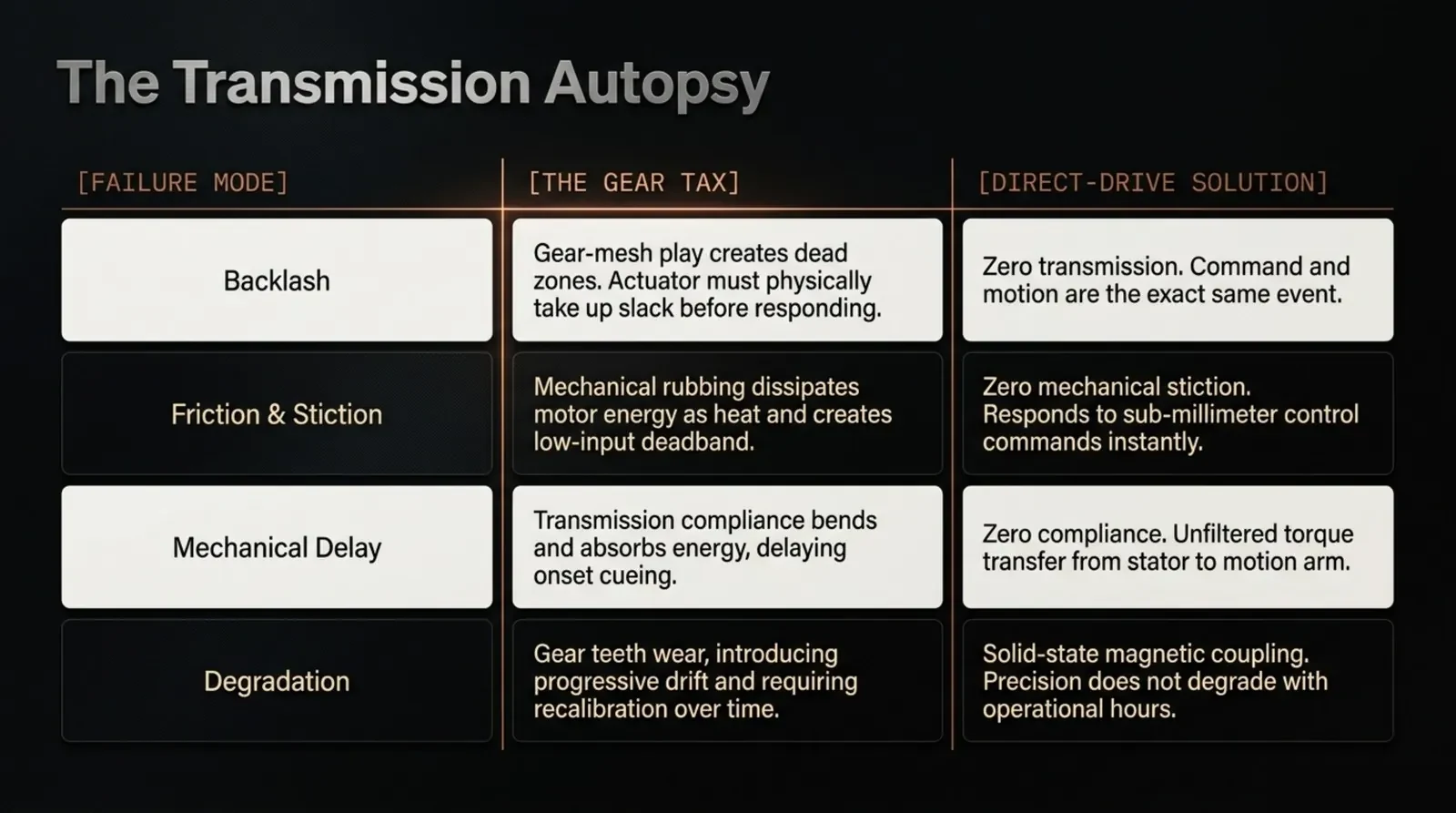
Nothing in the path to take upFour failure modes, and what removing the gearbox does to each
Keep reading
Direct drive
The architectural answer to this page: what removing the transmission actually removes, and what it asks of the motor instead.