No homing sequence
There is no start-up routine that drives each leg to a limit to find zero. The pose is known at power-on, which means the machine can refuse to move if the pose it reads is not one it should be in.
Engineering · Measurement
Direct drive removes the mechanism between the motor and the load. That only helps if the controller knows where the shaft is to a finer degree than the motion you are trying to produce. Every leg of the PDK carries a 21-bit absolute encoder, and the drive reads it on every cycle.
The number ›Absolute, not incremental ›What it does not buy ›
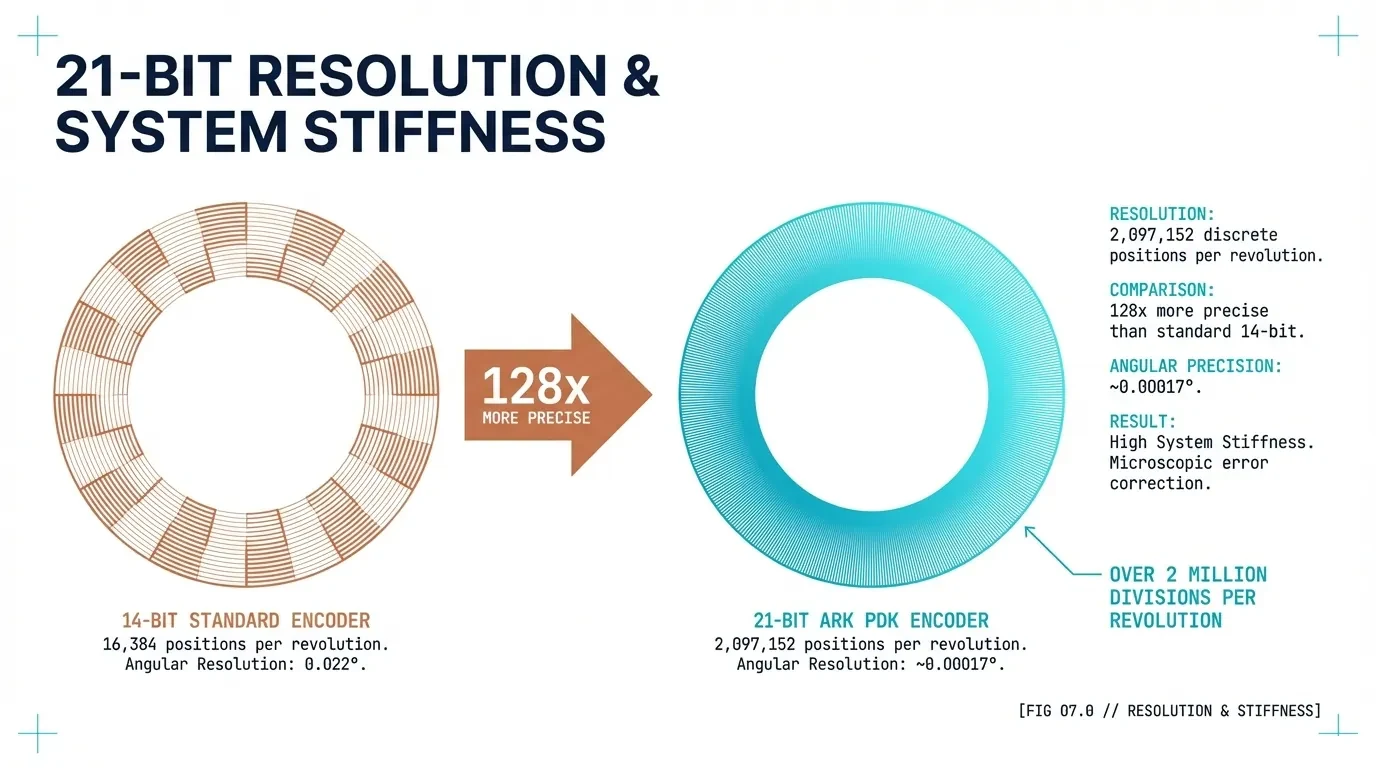
The number
Twenty-one bits gives 2 to the 21st distinct absolute positions per turn — 2,097,152 of them. Divide a full revolution by that and each step is 0.0001716 of a degree. The arithmetic is the whole claim; there is nothing to take on trust.
For scale
A 14-bit encoder is a common and perfectly reasonable part. Setting the two side by side is the clearest way to show what the extra bits are for — each bit doubles the count.
| Encoder | Divisions per revolution | Angular step |
|---|---|---|
| 21-bit (PDK) | 2,097,152 | 0.0001716° |
| 14-bit (baseline) | 16,384 | 0.022° |
| Ratio | 128× | 128× finer |
The 14-bit row is a comparison baseline, not a competitor's specification. We are not naming a product or claiming anyone ships one.
Absolute, not incremental
An incremental encoder counts steps from wherever it happened to be switched on. An absolute encoder reports a position. On a six-legged platform carrying a person, that difference is a safety property, not a convenience.
There is no start-up routine that drives each leg to a limit to find zero. The pose is known at power-on, which means the machine can refuse to move if the pose it reads is not one it should be in.
Lose power mid-motion and an incremental system loses its reference entirely. An absolute encoder gives you the same answer when it comes back, so recovery starts from a known state rather than a search.
Each motor shaft carries an MT6835 magnetic rotary encoder, sampled once per 125 µs drive cycle over SPI — the same cycle that closes the current and position loops. We name the part because a specification you cannot look up is not really a specification.
The boundary
Twenty-one bits describes how finely the encoder can divide a revolution. It does not describe how well that division corresponds to the true angle, which is a different property with its own error sources — mounting eccentricity, magnetic field distortion, thermal drift in the sensing element. A very high-resolution encoder mounted badly reports a very precise wrong answer.
Nor does encoder resolution propagate to the platform on its own. It reaches the platform only if nothing mechanical sits in between to absorb it, which is the argument on the direct drive page, and only if the control loop is fast enough to act on it, which is the argument on field-oriented control. The three claims only mean anything together.
You may see a figure of more than 100 kHz attached to encoder sampling for this platform. That is a capability figure for the sensing element, not the rate this system reads it at. This system reads it 8,000 times a second, once per drive cycle — an internal drive-loop rate, not a telemetry rate — and that is the number that describes the machine.
Keep reading
What the drive does with the encoder reading, 8,000 times a second (internal drive loop), on every motor.
Why fine measurement at the shaft is wasted if there is a mechanism after it.
The architecture that lets the encoder's resolution reach the platform at all.