The motors run cooler
A motor holding a static load draws current continuously and turns most of it into heat. Take the standing load off it and the thermal case becomes the motion itself, which is intermittent by nature.
Engineering · Load path
A direct-drive axis holds a static load by burning current, and current is heat. So on the PDK the standing weight does not sit on the motors at all — pneumatic cylinders take it, and the motors are left free to do the one thing only they can do.
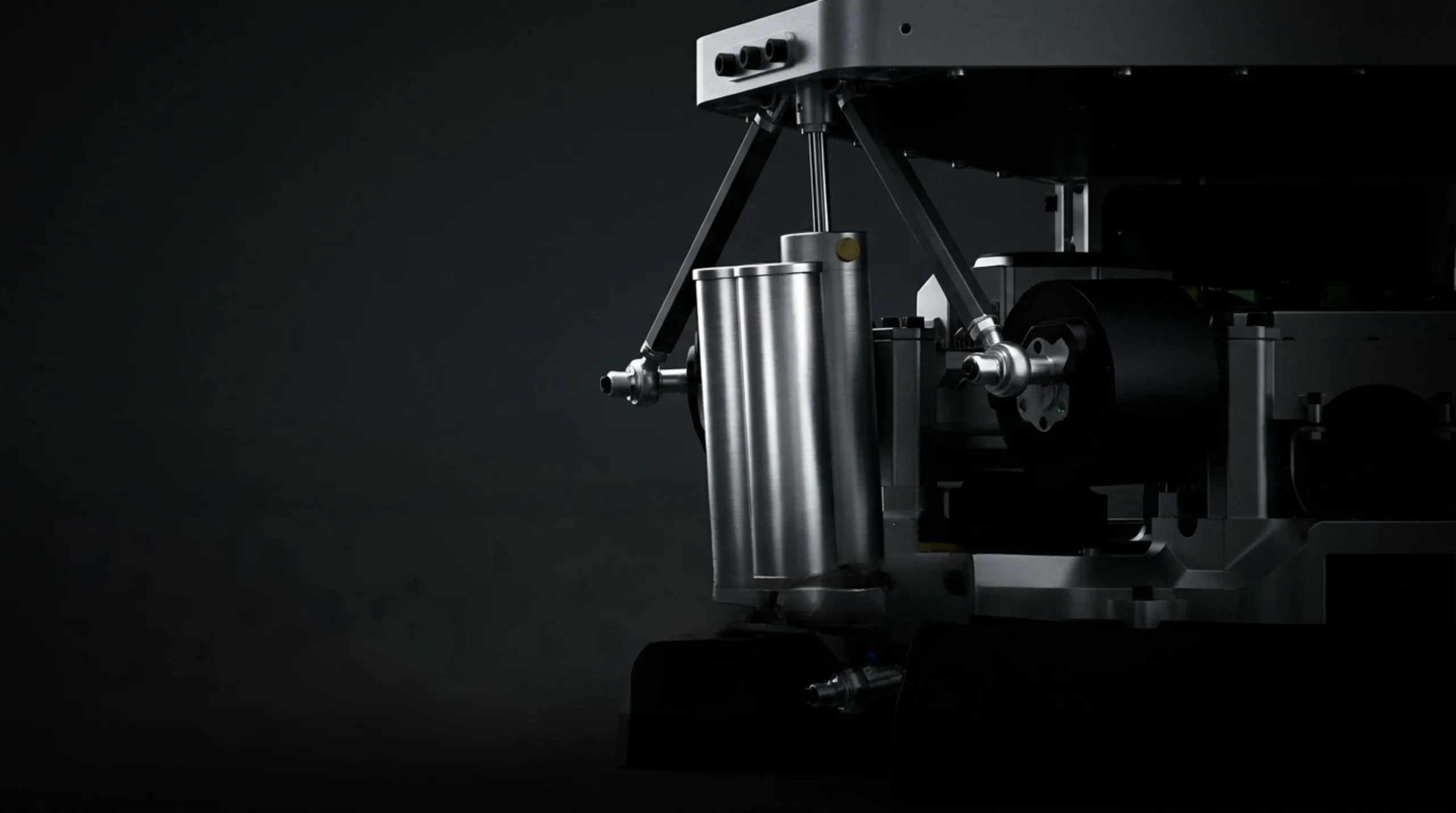
The split
Gravity changes only when the payload does — so it needs a spring, trimmed occasionally, not a fast control loop. Motion is the opposite: it changes continuously and needs a fast, precise, closed-loop actuator. Asking one component to do both means sizing an expensive, hot, high-bandwidth motor around a static load it never has to think about. So the PDK does not ask.
Two timescales, and the word passive belongs to only one of them. Between motion events the compensation is active: the Housekeeper reads the current the motors are drawing, and the compressor and valve manifold trim cylinder pressure until that current falls to near zero — the behaviour patent CA 3217174 C describes as detecting the current drawn by the positioning actuators and pressurising the cylinders to minimise their load. During motion nothing is being regulated: the valves are closed and the cylinders behave as air springs, which is why the legs below are called passive during motion rather than passive outright. Both halves matter — a spring alone would be wrong for every payload but one, and a fast pressure loop would put valve latency in the motion path.
What it buys
A motor holding a static load draws current continuously and turns most of it into heat. Take the standing load off it and the thermal case becomes the motion itself, which is intermittent by nature.
Whatever torque is not committed to holding the platform up is available to move it. The headroom goes into the part you can actually feel.
A pneumatic cylinder does not need electricity to keep pushing. Remove power from a platform whose weight is carried by air and it is designed to settle rather than drop — a property of the load path, not of a safety routine that has to run correctly.
Payload is published as up to 250 kg.
The arrangement
The load path is easier to picture once you count the legs. Six are motor-driven and produce every degree of freedom; three are pneumatic and do nothing but hold the platform up. They are arranged together, not bolted on afterwards.
| Group | Count | Role |
|---|---|---|
| Servomotor legs | 6 | Directly coupled rotary actuators. All active positioning and every degree of freedom comes from these. |
| Pneumatic legs | 3 | Part of the automatic weight-compensation system. Passive during motion — they carry, they do not steer. |
| Total elements | 9 | Arranged axially symmetric, in three clusters of three connection points. |
Not levitation
The platform is sometimes described as magnetically levitating its payload. It does not, and we do not use the word.
Magnetic levitation means suspending a mass in a field with no mechanical contact. Nothing in this system does that. The weight is carried by pneumatic cylinders and by the torque of permanent-magnet motors driving jointed legs — a load path made entirely of parts that touch each other. Permanent magnets inside a motor are not levitation; they are how the motor makes torque.
The correction matters beyond pedantry. The platform's actual behaviour under power loss — settling on air rather than dropping — is a real and useful property that follows from how the load is carried. Describing it as levitation replaces a checkable engineering fact with a phrase that sounds better and means less.
This is recorded in our own claims inventory as an internal contradiction on the current live site: the same site describes the pneumatic weight-bearing arrangement correctly elsewhere. Where two published statements disagree, this site publishes the one that matches the machine.
Keep reading
Why holding a load with current is a problem worth designing around in the first place.
What the motors do with the torque this arrangement frees up.
Patent CA 3217174 C and what it actually covers.