High frequency: move
Kerbs, surface texture, the first instant of a braking event. These are short, and the platform has enough travel to reproduce them faithfully. This is the part that feels like detail.
Engineering · Signal
Accelerate for ten seconds in a game and the car has moved several hundred metres. The platform has a fraction of a metre. Motion cueing is the set of filters that decides which parts of that motion you are given, which are traded for something you cannot distinguish from it, and which are quietly dropped.
The problem
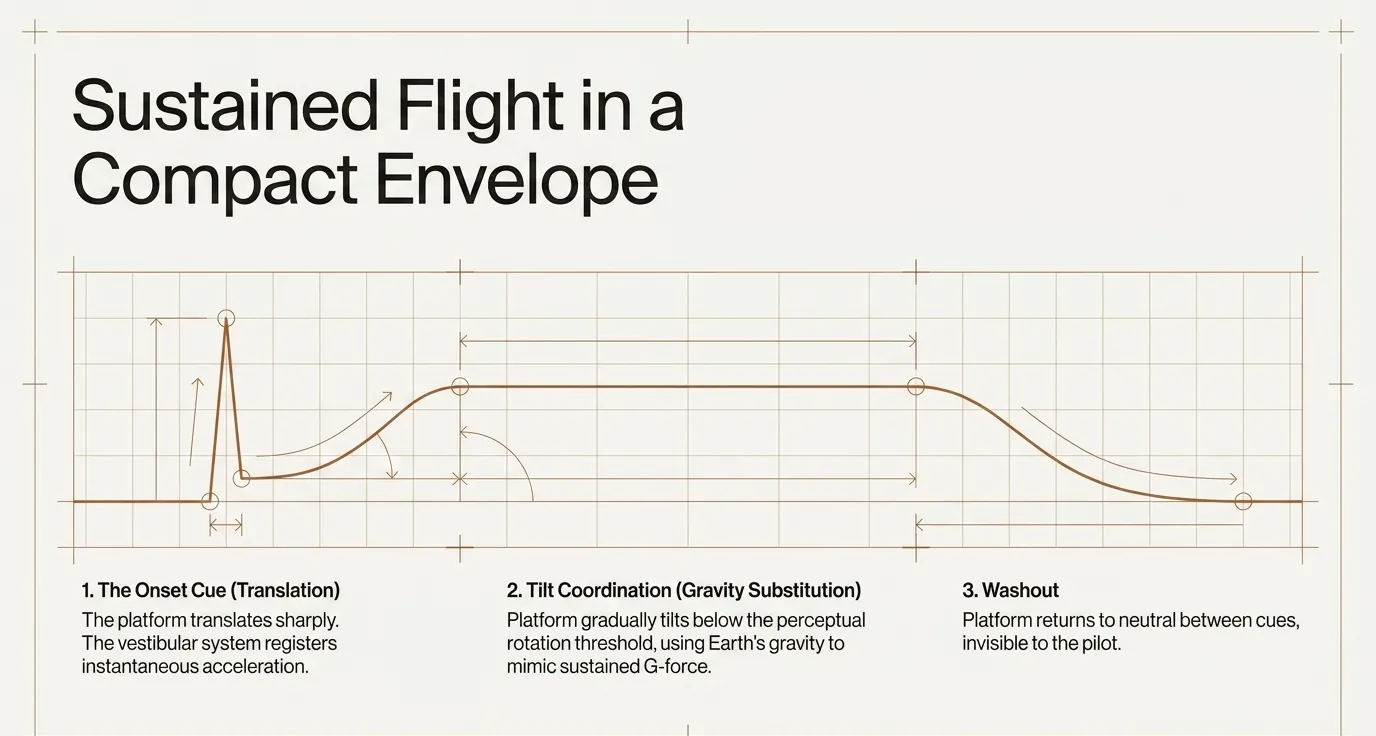
A platform can accelerate you briefly, then it runs out of room. But your inner ear does not measure acceleration directly — it measures the direction of the force acting on you. Tip a seat back and gravity does part of the job that acceleration was doing. The onset is given by moving; the sustain is borrowed from gravity by tilting. Done well, you never notice the handover.
Washout
A washout filter splits the incoming motion by frequency and treats each part differently — and then, crucially, returns the platform toward centre slowly enough that the return is not itself a cue.
Kerbs, surface texture, the first instant of a braking event. These are short, and the platform has enough travel to reproduce them faithfully. This is the part that feels like detail.
Sustained cornering and long braking zones would exhaust the envelope in under a second. They are handed to tilt coordination instead, which can hold the sensation indefinitely.
After every excursion the platform has to get back to the middle, ready for the next one. The return is made slow enough to sit under perception — if you feel the washout, the filter has failed.
The washout DSP runs at 20 kHz internally, well above the rate at which the game supplies new data. That headroom is what lets the filter be smooth rather than stepped between telemetry frames.
Why this is the hard part
Two rigs with identical actuators, identical envelopes and identical latency can feel entirely different, and the difference is almost always here. Hardware sets the ceiling on what is possible; cueing decides how much of that ceiling you actually get.
It is also the part that resists specification. There is no number for cueing quality on any spec sheet, because the thing being optimised is a perceptual judgement — how much substitution a person will accept before the illusion breaks. That threshold varies between people, between titles, and with how long you have been in the seat.
Which is why this page does not quote thresholds. The specific figures for what the body detects are a live research question, and we would rather describe the mechanism accurately than borrow a number whose method we cannot show you. The longer argument, including what we do and do not think is established, is set out in the motion fidelity thesis.
What we will say is architectural: the platform's job is to execute the cue faithfully and quickly, and the cueing stage's job is to produce a cue worth executing. A fast, stiff, backlash-free machine makes good cueing audible. It does not make bad cueing good.
Keep reading
The parallel geometry the cue has to be executed through.
Where the cueing stage sits in the path, and the two budgets either side of it.
Why the motors are free to spend their budget on the cue rather than on gravity.