Titles
Through FlyPT Mover: Microsoft Flight Simulator 2020 and 2024, X-Plane 11 and 12, DCS World, IL-2 Sturmovik, Prepar3D and FSX — reached through each simulator's own data layer rather than a screen-scrape.
Industries · Aviation
Consumer flight seats pivot in pitch and roll and stop there — no translation, no yaw, no vertical authority. The PDK gives you all six, which matters because flying is mostly slow attitude with fast texture written on top of it.
What each axis gives you ›Sustained flight, compact envelope ›What this is not ›
What each axis gives you
A pivot seat gives you two of these. The remaining four are where most of the information about the aircraft's state actually lives.
| Axis | Kind | What it tells you |
|---|---|---|
| Surge | Translation | Takeoff acceleration you lean back into, braking after touchdown, thrust changes felt before the gauges move. |
| Sway | Translation | Crosswind drift and sideslip — the lateral push that says the approach is less stabilised than the instruments suggest. |
| Heave | Translation | Turbulence, thermals, ground effect cushioning into the flare, runway seams, and the shock of a firm arrival. |
| Pitch | Rotation | Rotation, climb and descent attitude, the flare, and stall buffet as high-frequency texture over a sustained attitude. |
| Roll | Rotation | Coordinated turns with direct-drive smoothness, from rate-one to aerobatic onset. |
| Yaw | Rotation | Rudder work, asymmetric thrust and crosswind alignment. The axis a pivot seat does not have. |
Sustained flight, compact envelope
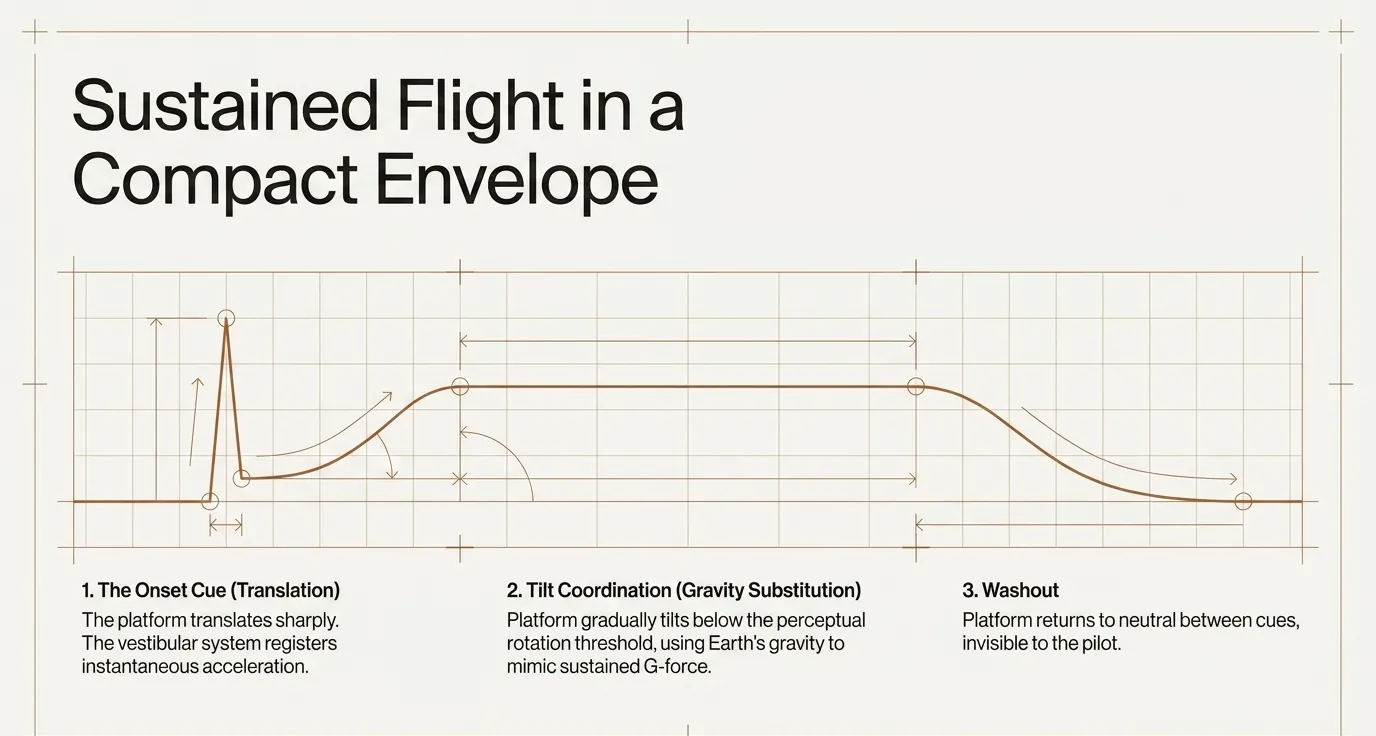
The technique is onset cueing with tilt coordination: move sharply to give the onset, then tilt slowly so gravity carries the sustain. Done below the threshold of notice, the handover is invisible.
Through FlyPT Mover: Microsoft Flight Simulator 2020 and 2024, X-Plane 11 and 12, DCS World, IL-2 Sturmovik, Prepar3D and FSX — reached through each simulator's own data layer rather than a screen-scrape.
The PDK is the motion base: up to 250 kg payload on 1.00 × 1.00 m for the PDK platform, 1.20 × 1.00 m for the PDK Racer — the chassis extends one face by 200 mm. Builders mount their own structure, and control-loading yokes, Honeycomb or Winwing hardware and avionics integrate as they normally would.
The envelope covers hover work: small sustained attitude offsets, the transition through translational lift, and cyclic and collective texture as vibration over the top of it.
The cueing argument in full is on the motion cueing page, including why we do not publish perceptual threshold figures.
What this is not
The PDK is supplied as a research and engineering instrument. It is not a certified Flight Training Device or Full Flight Simulator under FAA 14 CFR Part 60, EASA CS-FSTD(A) or the equivalent authority in your jurisdiction, and we make no claim that it is. A programme that needs a type-rated Level B, C or D device needs a qualified simulator. The PDK is for the work around and beneath that: research, engineering, curriculum development, procedures and familiarisation.
Keep reading
The same architecture for programme work, and the same certification statement stated at programme scale.
Onset, tilt and washout — the technique this page depends on.
PDK at $4,899.99 is the raw platform, and the usual starting point for a cockpit build.