Training research
Research into spatial disorientation and upset prevention and recovery cueing.
Portal Development Kit (PDK): this is a development kit.
Uses · Aerospace
The Stewart-Gough hexapod is the canonical architecture beneath full flight simulators, because parallel kinematics is what reproduces coupled multi-axis attitude change. The Portal Development Kit (PDK) is that architecture, supplied as a development kit for research and engineering rather than as a qualified device.
Development Kit: early-access hardware, software in active development.
First, plainly
The PDK is not a certified Flight Training Device or Full Flight Simulator under FAA 14 CFR Part 60, EASA CS-FSTD(A) or an equivalent authority, and nothing on this site claims otherwise. Certification is type-specific, device-specific and awarded to an operator's program — it is not a property a motion base can carry. A program that needs a qualified Level B, C or D device needs one. This is for the work around and beneath that.
Development uses
Research into spatial disorientation and upset prevention and recovery cueing.
Run candidate aerodynamic models through the same motion delivery as a reference, or place the platform in a hardware-in-the-loop chain for system-level testing.
Vehicle-feel cueing research for drone and UAV programs; integrating it with your ground-control software is your work.
Response time
FAA 14 CFR Part 60 lets the motion system of a certified helicopter flight training device lag up to 150 ms behind the pilot's control input. The PDK goes from input to motion in under 1 ms, counted from the input reaching the platform, and reaches 3 g on all six axes, fully loaded (250 kg).
Your cueing, your stack
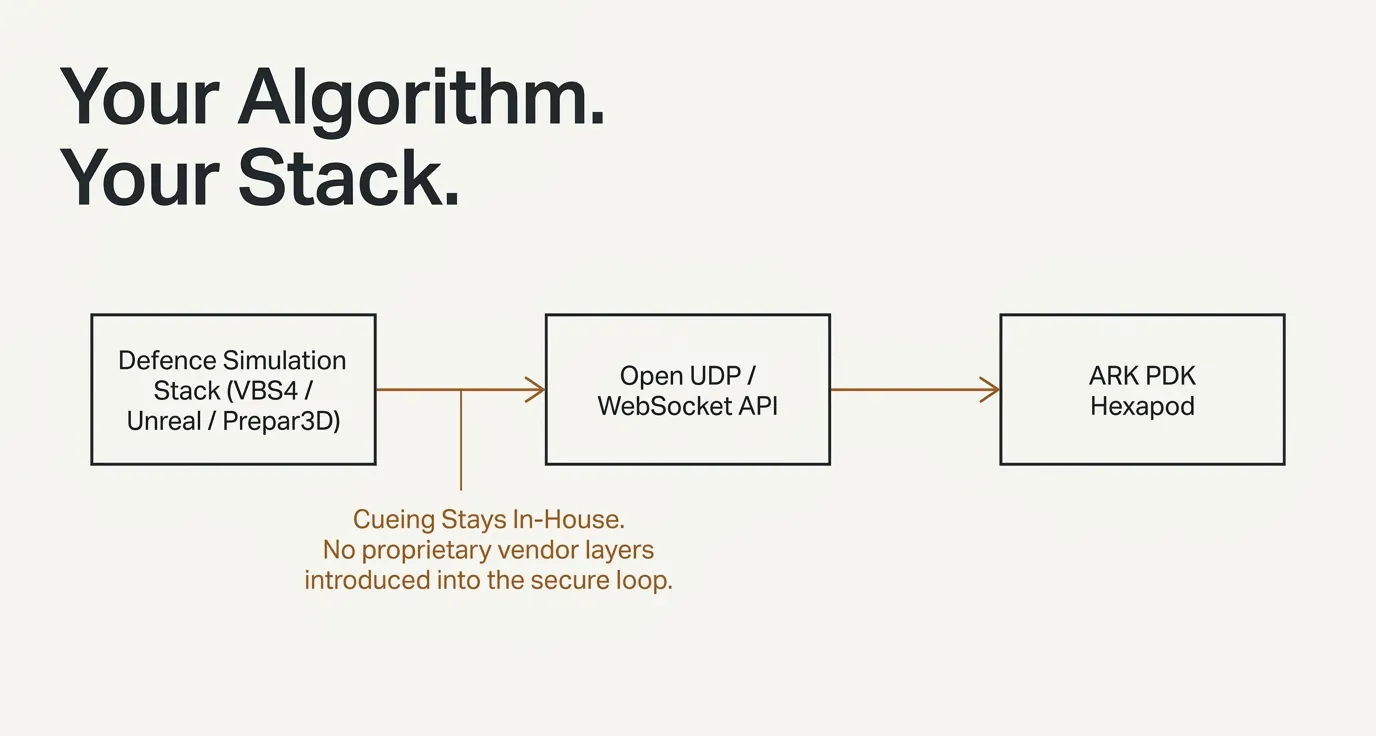
Aerospace and defense programs write their own motion cueing, often under restriction. The platform takes a six-axis pose over an open UDP interface and executes it.
Your cueing runs in your simulation stack.
Game-to-motion commands arrive at 1 kHz into a 3.3 kHz control loop.
The architecture is patented technology. For multi-station orders, contact us.
Keep reading
The same platform from the pilot's seat, and the same certification statement.
Onset, tilt and washout — the technique every program here depends on.
For a question a page cannot answer.