Repeatable to engineering tolerance
21-bit absolute encoders resolve 2,097,152 positions per revolution — 0.618 arcseconds per increment, which is the same figure as 0.0001716 degrees and can be recomputed from the bit depth.
Industries · Robotics
Robotics and industrial work judges a motion platform on engineering tolerances rather than on how it feels. The relevant properties are repeatability, the absence of mechanical play, and whether the thing will accept commands from your stack without a vendor layer in between.
Four properties
21-bit absolute encoders resolve 2,097,152 positions per revolution — 0.618 arcseconds per increment, which is the same figure as 0.0001716 degrees and can be recomputed from the bit depth.
Gear meshes and harmonic drives introduce play that compounds across cycles. There is no gearbox, belt or ballscrew here to introduce it. That is a statement about construction, not a measurement.
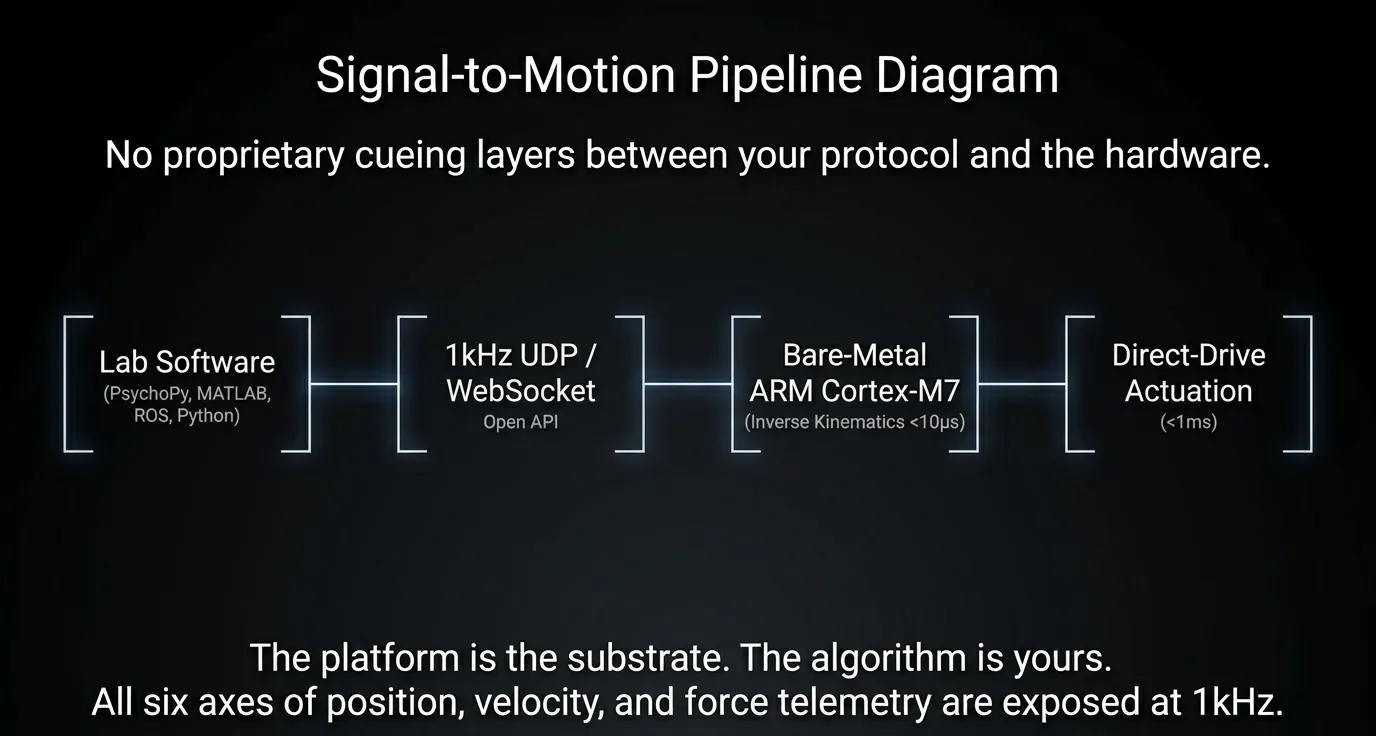
The platform is one node in a hardware-in-the-loop chain: position commands in at 1 kHz internally, telemetry back out.
Direct drive removes the consumable transmission parts — gearboxes, oil, brushes — that wear under continuous cycling.
The work it suits
Inverse-kinematics solver validation and model-predictive control on the canonical Stewart-Gough architecture, with a documented machine underneath.
A controlled dynamic platform for IMU, camera and LiDAR stacks, drone IMU validation and ADAS bench work.
Camera intrinsic and extrinsic calibration, gimbal stabilisation rigs, optical-axis alignment and target positioning.
Integration
The platform accepts six-axis pose commands over UDP and exposes telemetry over open interfaces. There is no proprietary layer to adopt and no SDK to keep current — which matters most for the hard real-time targets that will not tolerate one. If your work needs to sit below the pose interface, direct actuator mode gives you the six legs and the solver gets out of the way.
Keep reading
The three nested loops, and what closing a loop on the motor shaft does and does not tell you.
The geometry, and the three ways parallel kinematics is genuinely harder.
For a deployment, a protocol, or a question a page cannot answer.