Journal ·
Two axes, three or six:
what each one lets you feel.
Braking should shove you forward into the belts, a kerb should kick up through the seat, and a rear end letting go should turn you with the car. A 2DOF platform tilts you on pitch and roll, a 3DOF platform adds heave or yaw, and a 6DOF platform moves you on all six axes, so braking arrives as a push forward and the rear stepping out as a rotation. ARK's PDK is a six-axis platform: its published envelope spans 158.23 mm in surge and 19.60° in yaw, single-axis, read from its T1 firmware boot banner.
What does the DOF number count?
A degree of freedom (DOF) is one independent way a body can move. A car, a cockpit and the person in the seat each have six: three translations, surge (forward and back), sway (side to side) and heave (up and down), and three rotations, roll, pitch and yaw. A motion platform's DOF number is how many of those six it can move you in.
The number counts axes, not actuators. Four actuators under the corners of a cockpit make three axes; six legs working in parallel make six. Each of the six is defined on the Stewart platform page, and what each tells a driver on the sim racing page.
Which axes does each layout move?
An axis a platform does not move is either left out or, for surge and sway, stood in for by tilt. Axis by axis:
| Axis | What you feel | 2DOF | 3DOF | 6DOF |
|---|---|---|---|---|
| Surge | The push forward under braking, back under throttle | Tilt stands in | Tilt stands in | Moved |
| Sway | The sideways load of a corner | Tilt stands in | Tilt stands in | Moved |
| Heave | Kerbs, crests and compressions, from below | Not moved | Moved on heave layouts | Moved |
| Roll | The lean into and out of a corner | Moved | Moved | Moved |
| Pitch | The nose diving under brakes, squatting under power | Moved | Moved | Moved |
| Yaw | The rear stepping out, as rotation | Not moved | Moved on yaw layouts | Moved |
“Tilt stands in” means the platform leans the seat so that gravity presses on you the way a long acceleration would. Tilt carries the sustained part of a corner or a braking zone. The first instant of one needs the seat to travel.
What can two axes reproduce?
A 2DOF platform rotates you on pitch and roll. Pitch gives the nose dive under braking and the squat under power; roll gives the lean of a corner. Tilted slowly, the same two axes also stand in for sustained braking and cornering.
Surge, sway, heave and yaw are not in a two-axis platform's kinematics. A braking zone arrives as a tilt, never as a push, and the rear stepping out arrives as a lean. Some two-axis designs move the seat alone, inside a cockpit that stays still, so the wheel and pedals do not move with you; others carry the whole cockpit.
What does a third axis add?
A 3DOF platform adds heave or yaw to pitch and roll. Heave is travel straight up and down: kerb strikes, crests, the compression at the bottom of a dip. Yaw is rotation about the vertical axis: the rear of the car stepping out.
A four-post layout puts an actuator under each corner of the cockpit. Raising and lowering corners gives pitch, roll and heave, and leaves surge, sway and yaw out of its kinematics. A yaw layout keeps pitch and roll and turns the rig about the vertical instead of lifting it.
What do six axes move?
A 6DOF platform moves you on every axis: surge, sway and yaw as well as heave, pitch and roll. A Stewart platform, the layout of ARK's PDK, does it with six motor-driven legs working in parallel between the base and the top plate. Every pose is a combination of the six axes, and all six legs move together to make it.
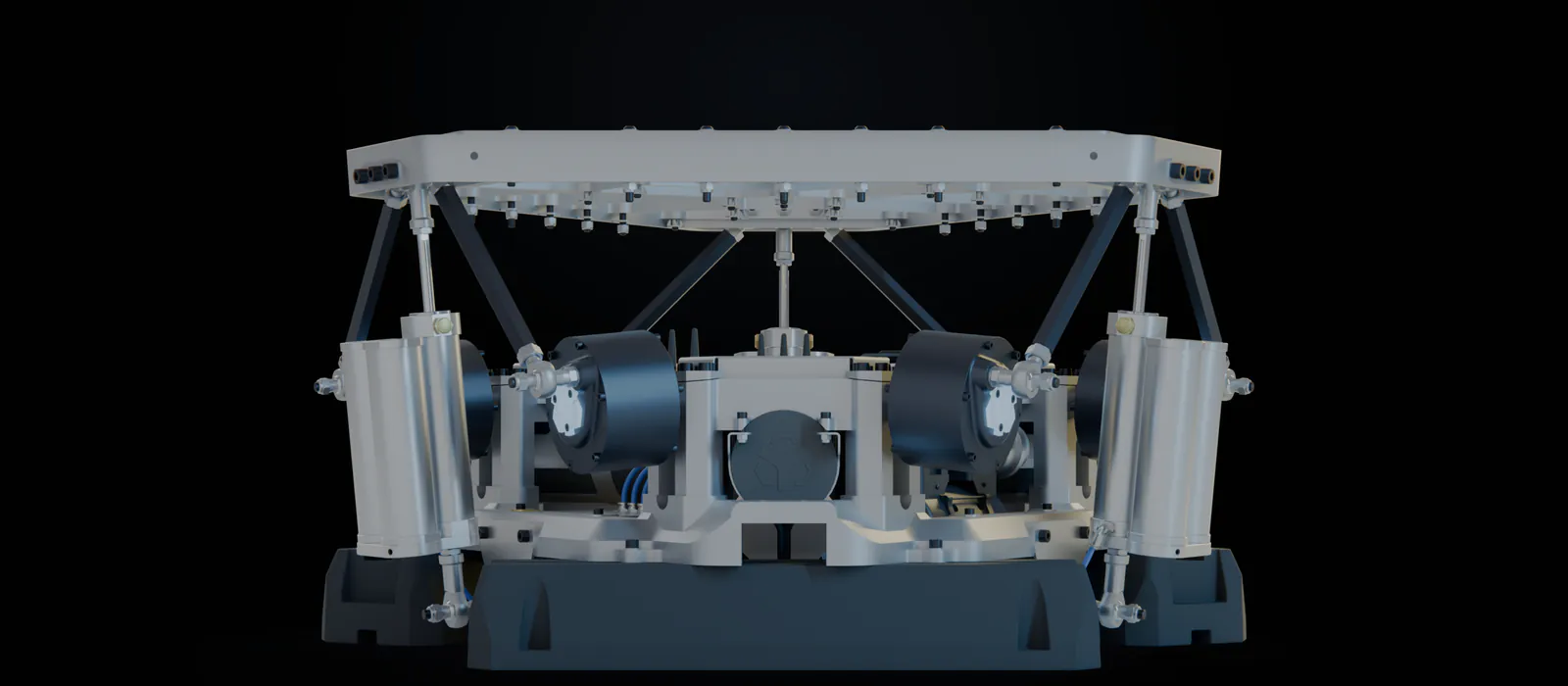
This is where the feeling changes. A braking zone arrives as a push forward before anything tilts. A car stepping out at the rear arrives as a rotation of the cockpit, with the sideways slide that sway carries. A kerb arrives from below. The rider clips on See it move show a six-axis platform at work.
Six axes do not retire the tilt. Travel ends on every platform, so on six axes too the long part of a braking zone or a corner is borrowed from gravity, and the platform returns toward centre slowly enough that the return is not itself a cue. What six axes change is how a brake or a corner begins, and the moves a tilt cannot make at all: the slide and the turn. How the hand-over from travel to tilt is tuned is motion cueing, and it shapes the ride on any number of axes.
How far does the PDK move on each axis?
The PDK is ARK's six-axis platform. Each of its six motor-driven legs has its own direct-drive motor, with no transmission in the load path: the motor turns an arm, and a fixed-length rod carries the motion up to the top plate. Its published envelope:
| Axis | Range | Total span |
|---|---|---|
| Surge | −75.49 … +82.74 mm | 158.23 mm |
| Sway | ± 71.92 mm | 143.85 mm |
| Heave | ± 58.68 mm | 117.35 mm |
| Roll | ± 8.68° | 17.36° |
| Pitch | −7.98° … +8.09° | 16.07° |
| Yaw | ± 9.80° | 19.60° |
These are nominal single-axis limits, each with every other axis at neutral, read from the T1 firmware boot banner (7 July 2026 capture) and published on the technology page. The axes trade against each other, so no axis reaches its single-axis maximum while the others are working, and the firmware refuses a pose outside the envelope rather than clamping it.
Peak acceleration is 3 g, the firmware's safety limit, with up to 250 kg on board. That 250 kg is the total the platform carries, rider, seat, cockpit, wheel and pedals together, as the rated limits state. The base is 1.00 × 1.00 m on its own feet, or a 1.57 m circle on the extension feet (size and weight).
How do you choose the number of axes?
Start from the cues you want as movement. Pitch and roll: two axes move them. Kerbs and crests: heave. The push of a braking zone, the sideways step of a slide and the rotation of the rear are surge, sway and yaw. A six-axis platform moves all three, and hands only the sustained part of a braking zone or a corner to tilt.
Then ask four things of any platform, whatever its axis count:
- Which axes it moves, by name, not by number.
- How far it moves on each, and whether the figures are single-axis or combined.
- At what payload its acceleration figure is quoted, and whether that payload is a total or the rider alone.
- What moves with you: the seat alone, or the wheel and pedals too.
The axis count sets the ceiling; cueing decides how much of it you get. Published prices for two-, three- and six-axis platforms, each read from its maker's page, are on the motion simulator prices page.
- The six spans: the PDK's T1 firmware boot banner, 7 July 2026 capture, published as the nominal envelope ark-dynamics.com/technology
- 3 g peak: the firmware's safety limit ark-dynamics.com/technology/stewart-platform
- 250 kg: the rated total payload, rider included ark-dynamics.com/safety
- Footprint: 1.00 × 1.00 m on its own feet, a 1.57 m circle on the extension feet ark-dynamics.com/faq
Every PDK build starts with the same six-axis platform.