Journal · Before you buy
Decide what you want
to feel. Then ask for
the numbers.
What you feel on a motion platform comes down to five things you can ask any maker for: which axes it moves, whether its payload rating is a total, what acceleration it reaches at that payload, where its latency is measured from and to, and how fine a vibration it makes under load. ARK publishes the PDK's answers: six axes, 250 kg total payload, 3 g peak with up to 250 kg on board, under 1 ms from the game's telemetry reaching the platform to the actuator beginning to move, and vibration up to 629 Hz measured with up to 250 kg on board. Fit, delivery and price come after that.
ARK Dynamics ·
The feel
What you feel, and
the number behind it.
Braking moves your weight forward. A long corner leans you out. A crest lifts you, and when the rear lets go the car turns under you. Road surface comes up through the seat. That is what you are buying, and each part of it comes from something a maker can put a number on. Riders' own reactions, filmed as they climbed off, are on See it move.
| You want to feel | It comes from | Ask the maker | The PDK |
|---|---|---|---|
| Weight going forward, sideways and up; the car rotating under you | The axes it moves, and the travel on each | Which axes, and how far on each? | All six |
| Everything you sit in, moving with you | Payload | Is that figure the total, rider included? | 250 kg total, rider included |
| The shove of a hard stop, the jolt of a kerb | Acceleration | How many g, carrying how much? | 3 g peak with up to 250 kg on board, the firmware's safety limit |
| Motion that starts with the picture | Latency | Measured from where to where? | Under 1 ms, from the game's telemetry reaching the platform to the actuator beginning to move |
| Road surface through the seat | Vibration | What frequency, carrying how much? | 629 Hz, measured with up to 250 kg on board · up to 2,000 Hz on each motor |
Which movements does it make, and on how many axes?
Braking pushes you forward, a corner pushes you sideways and a crest lifts you. A degree of freedom is one direction a platform can move you: three translations, surge (forward and back), sway (side to side) and heave (up and down), and three rotations, pitch, roll and yaw. The car also turns about three axes. It dives and squats (pitch), leans (roll) and rotates when the rear lets go (yaw).
The PDK moves all six. ARK publishes the span of each, nominal and single-axis, as the controller's firmware reports it:
| Axis | What you feel | Span |
|---|---|---|
| Surge | Braking and acceleration | 158.23 mm |
| Sway | Cornering load, a slide | 143.85 mm |
| Heave | Crests, compressions, kerbs | 117.35 mm |
| Pitch | Dive under braking, squat under power | 16.07° |
| Roll | Body roll through a corner | 17.36° |
| Yaw | The rear stepping out | 19.60° |
What each axis tells a driver is set out on the sim racing page, and the full ranges on the technology page.
Is the payload rating a total?
Everything you sit in moves with you: the seat, the cockpit, the wheel, the pedals and you. A payload rating is the most weight a platform is rated to move, and the first thing to ask is whether it counts the rider alone or everything on board.
The PDK's is the total: 250 kg, the rider included along with the seat, cockpit, wheel, pedals and anything else bolted on. There is no separate rider-weight figure. The rated limits are on the safety page.
How much acceleration, carrying how much?
The shove of a hard stop and the jolt of a kerb are acceleration. Acceleration is how hard a platform can push you, measured in g. A g figure means little without the load it was reached with, because the same motors move an empty platform harder than a loaded one.
The PDK reaches 3 g peak, with up to 250 kg on board. 3 g is a safety limit set in its firmware. A platform gives you the onset of a force and then runs out of travel, so motion cueing tilts the seat and lets gravity carry the rest: how motion cueing does it.
When does the motion start, and what is the latency?
You want the dive to begin as the nose drops on screen. Latency is the delay between the game reporting a change and the platform moving, and it is a specification only when both measurement points are named.
The PDK's is under 1 ms, from the game's telemetry reaching the platform to the actuator beginning to move. The latency page sets out both points, and four questions to put to any maker are on the page about what datasheets leave out.
How fine a vibration can it make?
The road comes up through the seat. Vibration is the small, fast movement that carries texture: kerbs, the road surface, the engine. Its measure is frequency, and like acceleration, it means most when the load is stated.
The PDK reproduces vibration up to 629 Hz, measured with up to 250 kg on board, and each of its six motors reproduces up to 2,000 Hz. The motors drive the platform directly, with no transmission anywhere in the load path.
What you buy
Then the build: what fits,
what arrives, what covers it.
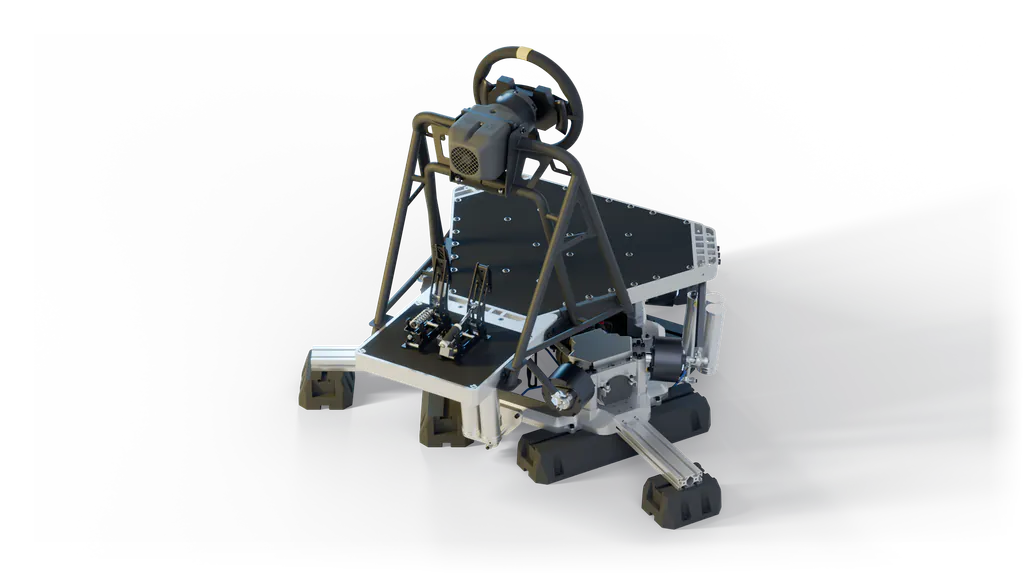
Will it fit your room and your socket?
The PDK takes 1.00 × 1.00 m on its own feet, and 1.57 m in diameter on the extension feet, which are three legs at 120°, so plan the space as a circle. Retracted, the platform stands 0.50 m high.
One power supply works on both kinds of socket: 3,000 W continuous on 200–290 V mains, 1,400 W on a 100–130 V outlet. The compressor is built in, so no air line is needed, and the platform connects to your PC over Ethernet. The keep-clear zone, floor load and mounting are stated in the Safety Manual supplied with your kit. The short answers are in the FAQ under size and power.
What drives it from your game?
The PDK works through FlyPT Mover and SimHub, with 80+ games supported locally. FlyPT Mover is a third-party tool, not ARK software; it reads a game's telemetry and turns it into motion. The compatibility list is on the support page.
What arrives, and what do you add?
Every build arrives as a kit: six to nine boxes by build, none over 26 kg, crated on a pallet and delivered to the kerb, with someone there to sign. Assembly runs in 14 steps, feet first; the box plan shows the order.
The four builds share one platform and add to it in turn: the extension feet and a wood table, then a racing chassis, then, in the PDK + ARK Ecosystem, a wheelbase, wheel, button box and pedals. No build includes a seat, PC, display or games. You add those.
When does it arrive, and what does it cost to land?
Your kit is expected to be ready 3 to 6 months from order confirmation. Shipping is not in the price: it is quoted for your address when your kit is ready. The Shipping Policy puts an unassembled kit to the USA at about USD 500, with every other destination quoted individually, and transit at 40 to 60 days from dispatch, plus customs.
Duty depends on where it goes. US prices include import duty, with sales tax shown at checkout. EU prices include VAT and import duty. Everywhere else, import tax and duty are paid on delivery. The details are under taxes.
What covers it once it is yours?
The kit carries a 24-month Limited Warranty from delivery. Consumers have 14 days from delivery to return the kit for any reason, and pay the return carriage. Before production starts, you can cancel for a full refund; the returns answer covers what follows.
The PDK is sold for private use, and private use includes streaming, making your own content and competing, prize money included. The conditions are in the Terms of Sale & Use.
What it costs
What each build costs.
Four builds of one platform. US dollars for the United States and the rest of the world; euros for the EU, with VAT and import duty included. Shipping is quoted separately.
| Build | What it adds | USD | EUR |
|---|---|---|---|
| PDK | The six-axis platform on its own feet | 4,899.99 | 4,999.99 |
| PDK + Extension Feet & Table | Extension feet and a wood table | 5,299.99 | 5,499.99 |
| PDK Racer | A racing chassis on top of that | 6,299.99 | 6,499.99 |
| PDK + ARK Ecosystem | Wheelbase, wheel, button box and pedals | 8,499.99 | 8,699.99 |
List prices on 1 October 2026. What other platforms cost, grouped by how many axes they move, is on motion simulator prices.
Every build starts with the same six-axis platform.