Between which two points?
A latency figure needs a start and an end. Command issued to actuator moving is a different quantity from telemetry received to platform moving, by an order of magnitude.
Compare · Method
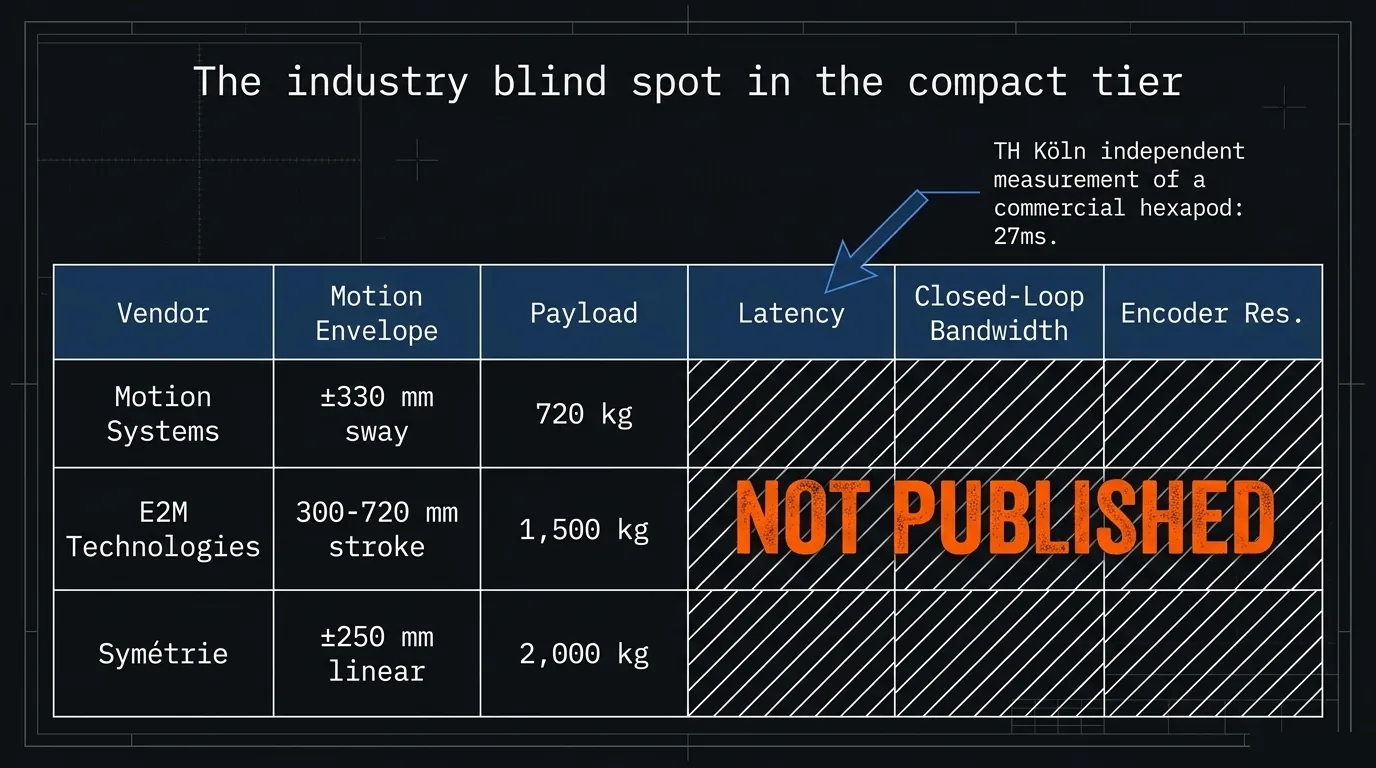
Every motion platform datasheet gives you envelope and payload. Almost none give you transport delay with its measurement boundary, frequency response under load, or what the control-loop number actually refers to. This page is the table we wanted to find and could not.
The method
"Sub-30 ms end-to-end" and "8 ms" are not comparable unless you know what each was measured between, under what payload, with what software in the chain. The same is true of a control-loop rate: 1 kHz can mean a command cadence, a servo loop, or a cueing-engine tick, and those are three different machines. So every row below carries a label — VENDOR for a published manufacturer figure, INTERNAL for one of ours, and "not published" where nobody states it at all.
Our own row first
It would be cheap to demand disclosure from other manufacturers and not give our own. So this is our row, held to the same standard.
| Specification | Figure | Basis |
|---|---|---|
| Encoder resolution | 21-bit absolute, 2,097,152 positions per revolution | Published, arithmetic checkable |
| Drive loop, per motor | 8 kHz / 125 µs | INTERNAL — read from the drive firmware timer |
| Inverse kinematics | 3.3 kHz | INTERNAL |
| Control loop | 1 kHz position commands over CAN at 2 Mbaud | INTERNAL — 1 ms period; the platform answers inside it |
| Transport delay | Under 1 ms — command issued to actuator moving | INTERNAL — boundary stated, which is the point |
| Frequency response under load | Not published | Not published |
| Motion envelope | Nominal (single-axis) only | On the technology page, from the T1 firmware boot banner. |
Our transport-delay row states a boundary because that is what this page asks of everyone else. Under 1 ms is the platform answering a command — not the journey from a game, which is 50 to 100 ms and mostly not ours. Both are published, with the path, on the latency page. A figure of 1.4 ms has circulated for this platform described as signal input to motion output; that wording claims the whole journey for a single hop, and it is not repeated here.
What to ask any vendor
These are the questions that separate a specification from a headline. They work on any manufacturer in this category.
A latency figure needs a start and an end. Command issued to actuator moving is a different quantity from telemetry received to platform moving, by an order of magnitude.
Frequency response and acceleration figures measured on an unloaded platform tell you very little about the platform with a person and a cockpit on it.
A command cadence, a servo loop and a cueing-engine tick are all quoted as "control rate". Ask which one, and what the others are.
A number with a test method and a report behind it is a specification. A number on its own is a claim.
Ask us these and the answers are on this page. Where a figure is not published, the row says so.
Keep reading
Our own transport-delay account, in full, including the figure we withdrew.
A protocol for measuring our latency independently, with no result claimed for it.
Ten pages, one subject each.