Citable
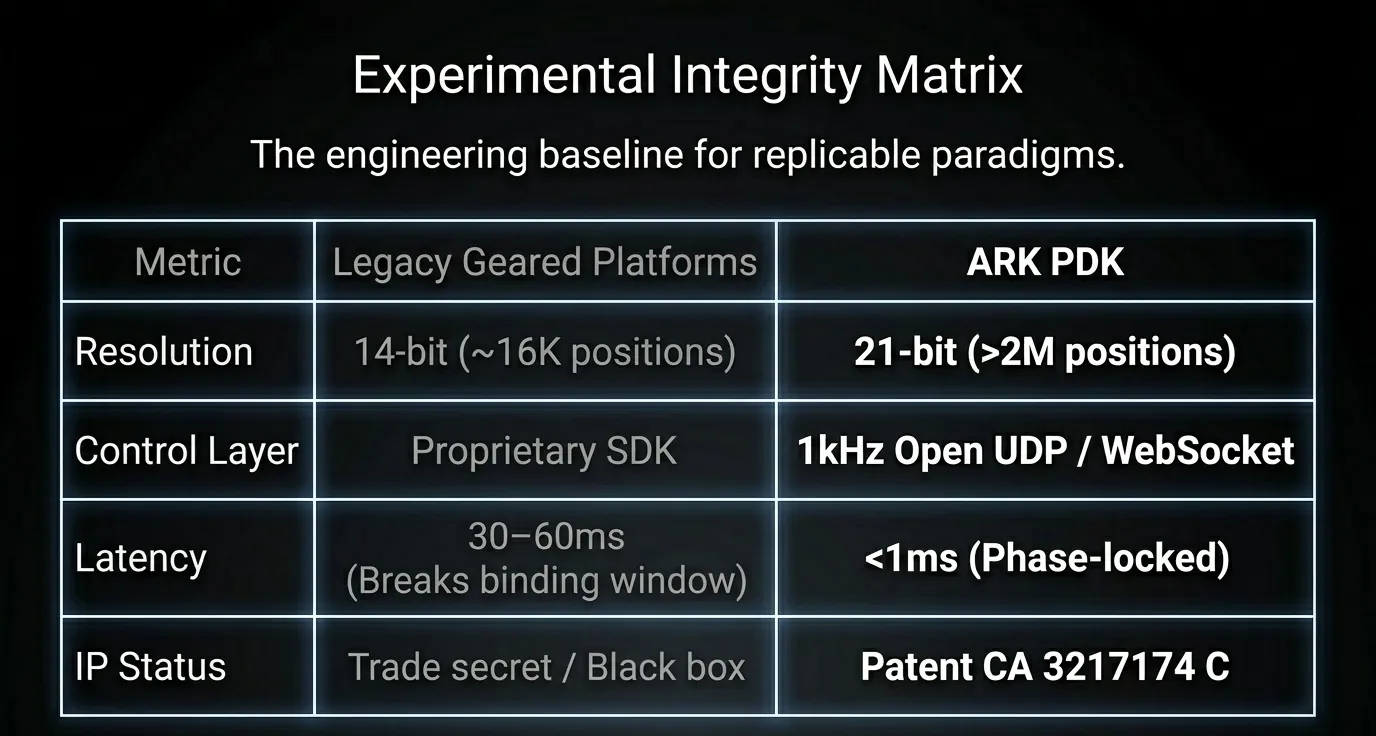
Per-axis envelope, encoder resolution and control rates are documented and stable, with patent CA 3217174 C as a verifiable reference for the architecture. This site prints measured figures with their sources.
Industries · Research
Academic work asks three things of an instrument that commercial rigs rarely offer: specifications stable enough to cite, motion delivery repeatable enough to reproduce, and an interface open enough to drive from whatever your laboratory already runs.
Four properties ›Three ways to drive it ›Verify it yourself ›
Four properties
Per-axis envelope, encoder resolution and control rates are documented and stable, with patent CA 3217174 C as a verifiable reference for the architecture. This site prints measured figures with their sources.
The same commands reproduce the same paradigm on another unit in another laboratory. No transmission means no mechanical play between the commanded position and the delivered one.
Experimental control software is heterogeneous. PsychoPy, MATLAB, Python, LabVIEW, ROS — anything that writes to a network socket drives the platform. There is no black box in the command path.
Instruments outlive grant cycles. Direct drive removes the consumable transmission parts — gearboxes, oil, brushes — that define service life on geared hardware.
Three ways to drive it
"Open API" means different things to different groups, so the platform supports three depths of access rather than one.
Existing integrations over UDP. No code. Standard motion paradigms out of the box, with telemetry available for synchronisation if you want it.
Your control software sends absolute six-axis pose commands — tilt five degrees forward, hold two hundred milliseconds. The housekeeper handles inverse kinematics and workspace limits.
Direct actuator mode bypasses the inverse-kinematics solver and gives you the six legs. The right tier if you are writing your own parallel-kinematics control.
Verify it yourself
Manufacturer specifications are a starting point, and a reviewer is entitled to want empirical verification specific to your payload, your integration software and your network. That is reasonable, and on this platform it is straightforward.
A workable protocol: tape a photodiode to the visual display surface, bolt a three-axis accelerometer to the platform near the centre of rotation, and stream both into a common timebase — Lab Streaming Layer is the usual glue for multi-modal synchronisation in experimental psychology. Trigger a step, and the interval between the photodiode edge and the onset of platform acceleration is your motion-to-photon figure for your configuration.
We are describing the method and claiming no result for it. Our own latency figure is under 1 ms, command issued to actuator moving — the boundary a reviewer would ask for is stated, and the end-to-end path is separate and published on /technology/latency/. If your measurement disagrees with anything we publish, we would like to see it.
Institutional use: contact us.
Keep reading
The neighbouring page, for work where motion is the stimulus rather than the apparatus.
The measurement chain your data ultimately rests on.
For a deployment, a programme, or a question a page cannot answer.