
Teaching with it
Tune a loop. Feel the overshoot. Three courses that can share one teaching platform.
STEM · University engineering
The Portal Development Kit (PDK) is a direct-drive six-axis motion platform, supplied as a development kit. Kinematics, control, motor control, sensing, mechanics and human perception all run inside it at once, each at a rate you can name. Each section below takes one subject, states the numbers, and links to the PDK technical reference and to how a 6DOF platform works.
Development Kit: early-access hardware, software in active development.
Kinematics ›Control ›Motors ›Sensing ›Energy ›Perception ›Software ›
Kinematics · mathematics
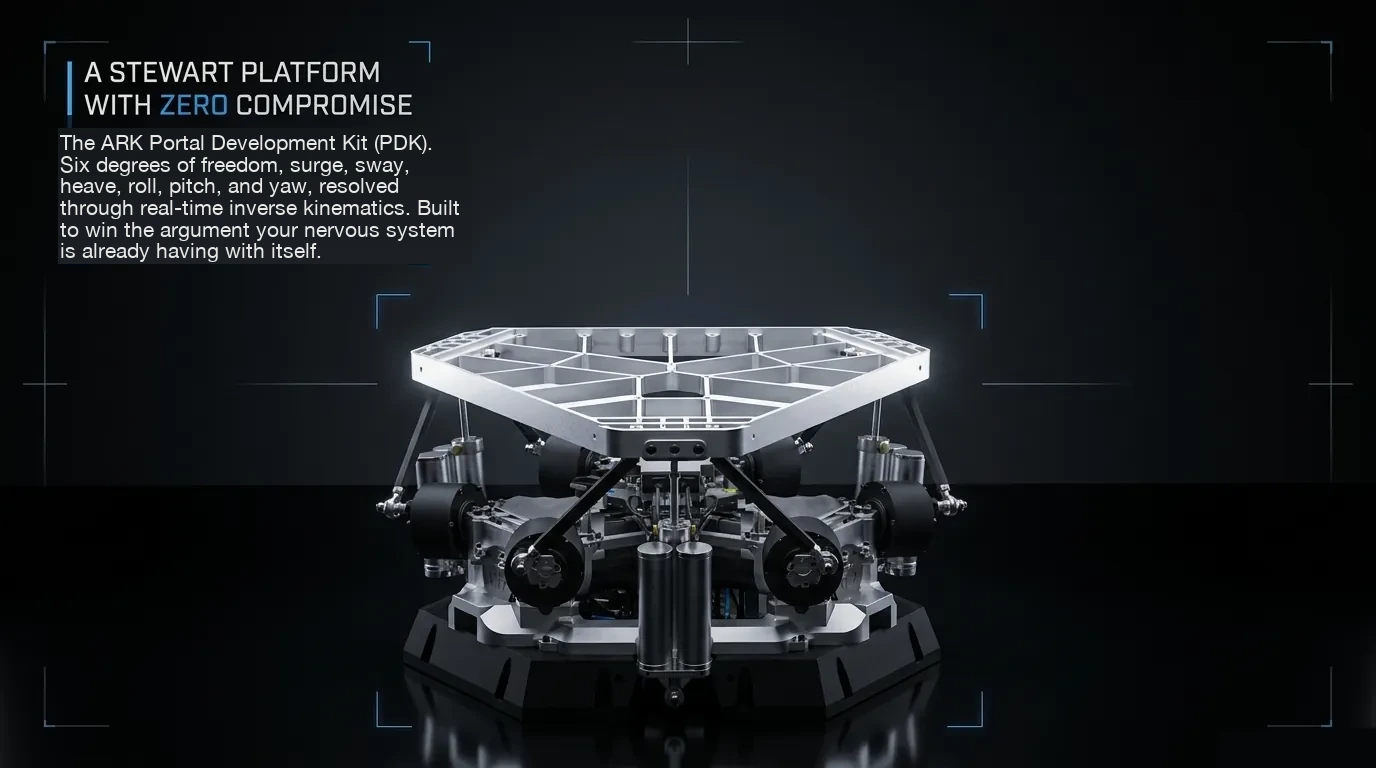
A 6DOF Stewart platform puts all six legs in parallel between a fixed base and a moving frame, so every leg shares every load. Working out leg lengths from a desired pose is tractable. Working out the pose from six measured leg lengths is the hard direction: why Stewart platform maths runs backwards.
In the PDK the inverse kinematics is a closed-form solution. The requested pose goes in and six leg lengths come out in under 10 µs, inside a control cycle of about 303 µs at 3.3 kHz: the closed-form inverse kinematics, in chapter 1. Any pose the platform can hold is a combination of the six axes, one by one, inside the motion envelope.
Control systems
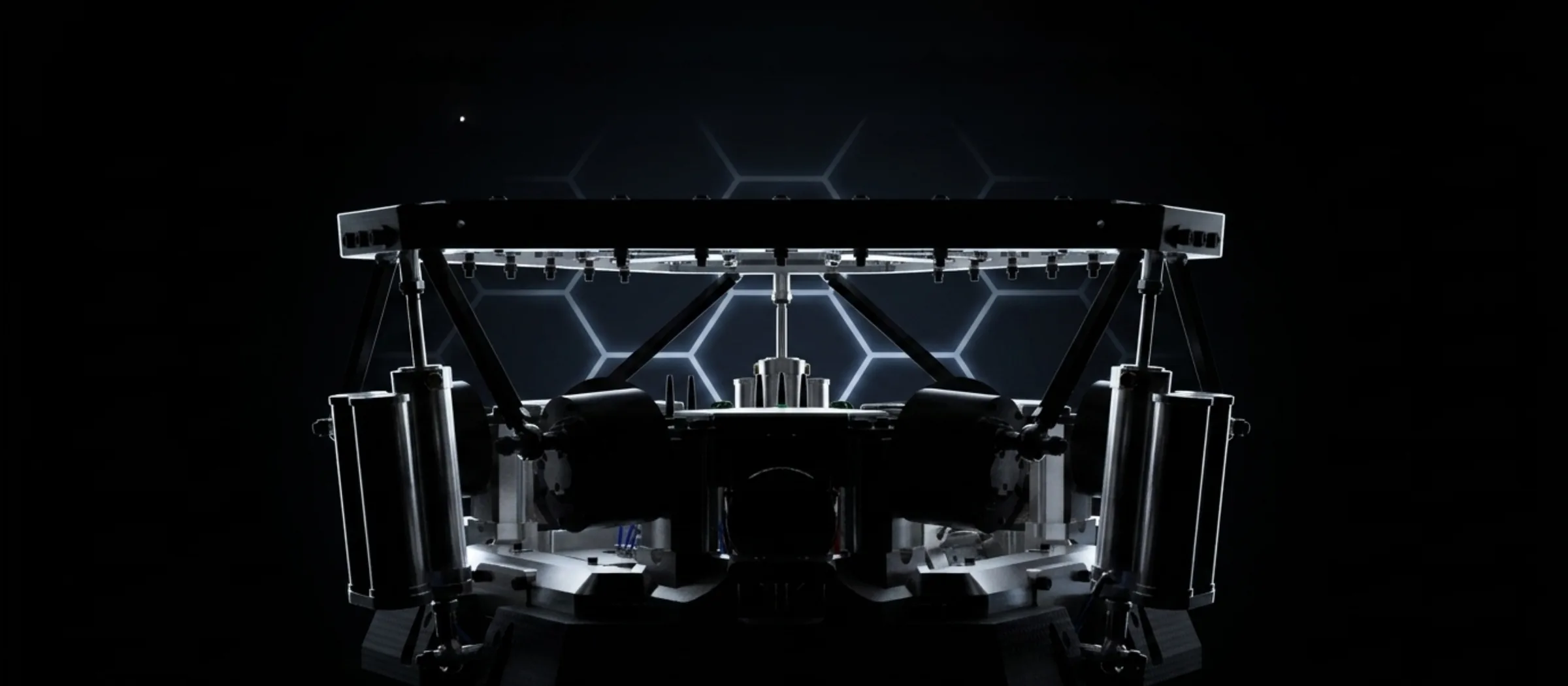
They run at different rates: the inner loop has to be faster than the thing it corrects, and the outer loops have less to do per cycle but more to reason about.
The three loops and what each compares ›What happens in each control cycle ›
| Loop | Rate | What it closes |
|---|---|---|
| Drive, per motor | 8 kHz | Position and current against a fresh encoder reading, every 125 µs |
| Control loop | 3.3 kHz | The requested platform pose against the six leg targets that would produce it |
| Game to motion | 1 kHz | A new pose for the platform every millisecond |
Electromagnetism · motor control
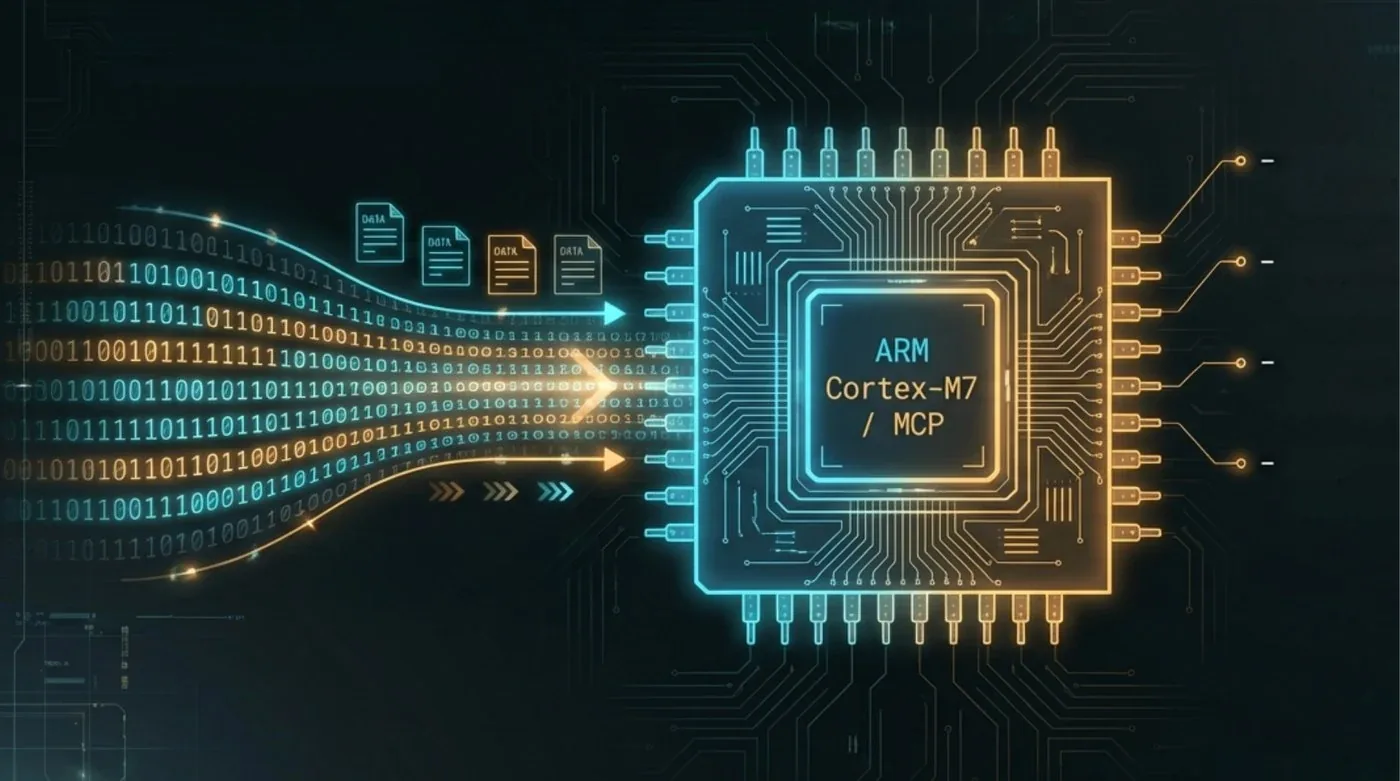
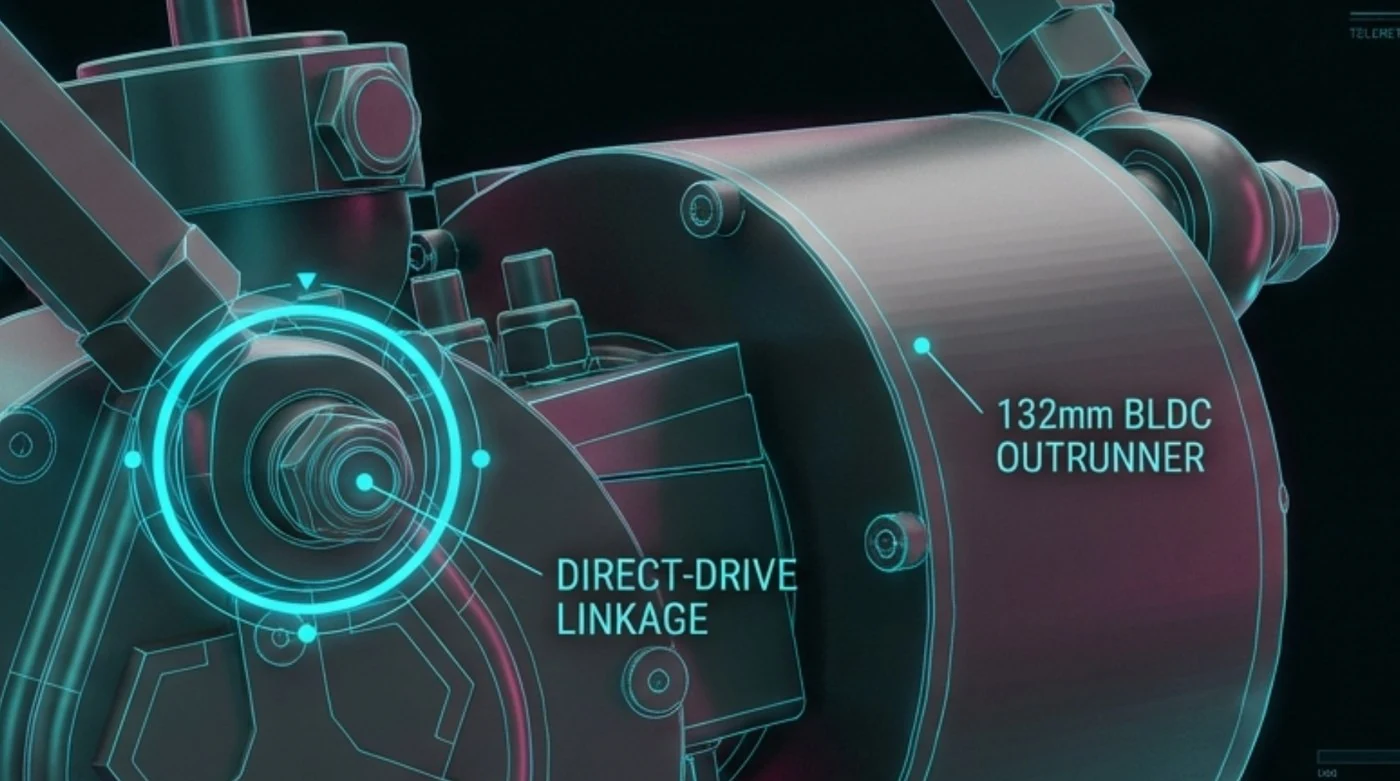
Each of the six direct-drive motors runs field-oriented control: phase currents resolved into torque-producing and field-producing parts, closed on a fresh 21-bit absolute encoder reading every 125 microseconds, on all six motors.
There is no gearbox, belt or reduction stage anywhere in the load path, so there is nothing between the motor and the load: what direct drive removes. With no gears there is no backlash, the gap before the motion. Six motors on three controllers: the direct-drive motor chapter.
Sensing · measurement
Every motor carries a 21-bit absolute encoder. Twenty-one bits gives 2 to the 21st distinct absolute positions per turn, 2,097,152 positions in one revolution, and each step is 0.000171661 of a degree. Absolute means no homing sequence, and the position survives a fault.
The second lesson is on the same page: resolution is not accuracy, and neither is precision. Magnetic against optical, absolute against incremental: the 21-bit encoder chapter.
Mechanics · energy
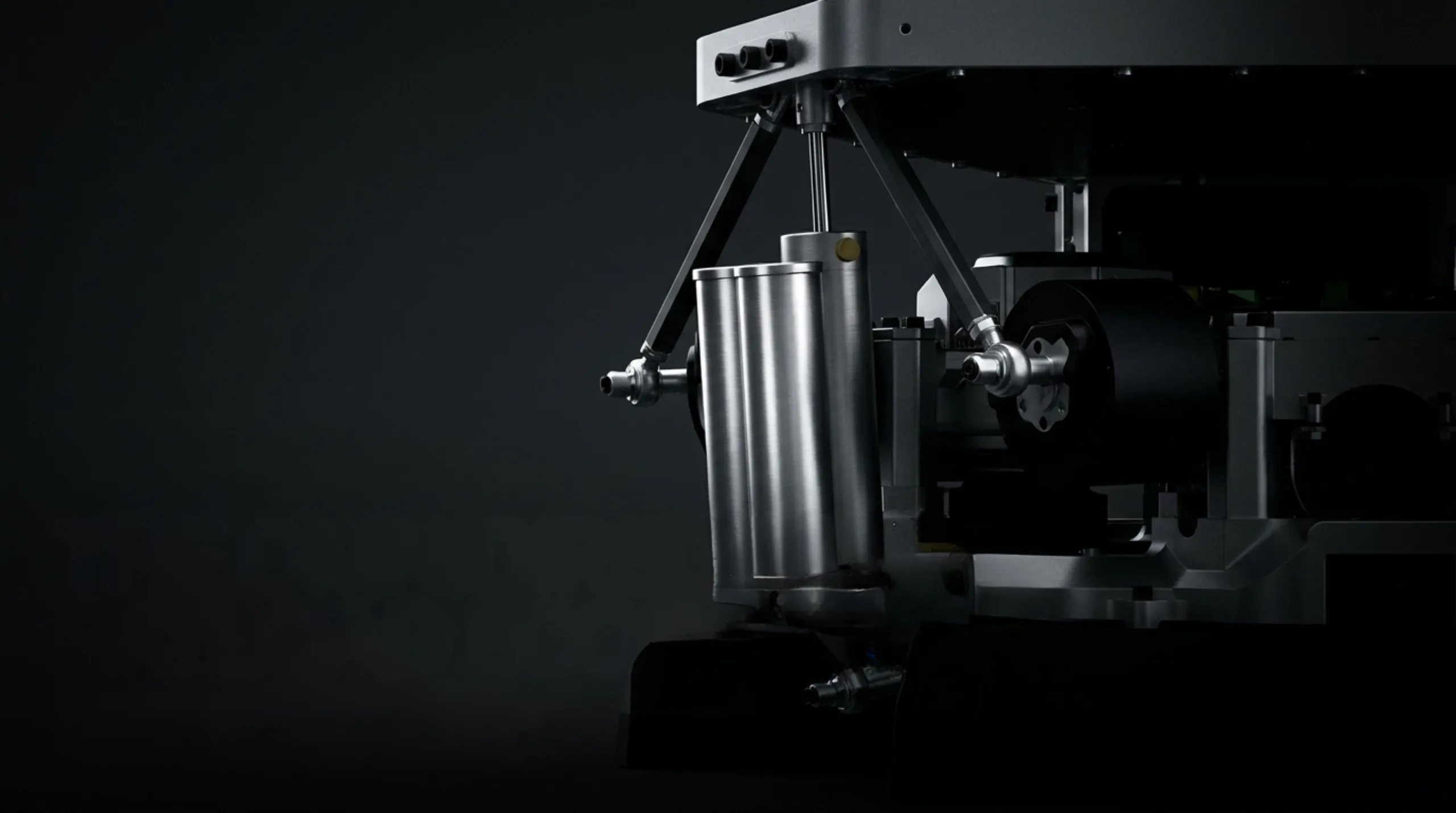
Gravity changes only when the payload does; motion changes continuously. Holding still and moving are different jobs, so the PDK gives them to different parts, and the split is patented: the patent page.
Maglev is our name for the friction and gravity compensation maps in the drive firmware: Maglev: friction and gravity compensation maps. A bank of three 0.47 F capacitors, 1.41 F in all, supplies a 30 kW burst: the power and capacitor chapter.
Signals · human perception
Five rates run inside the platform between the game and the leg: 20 kHz motion cueing, 1 kHz game to motion, a 3.3 kHz control loop, drive commands at 2.5 kHz or more, and 8 kHz field-oriented control on each motor. From game telemetry in to motion out takes under 1 ms: where the millisecond goes.
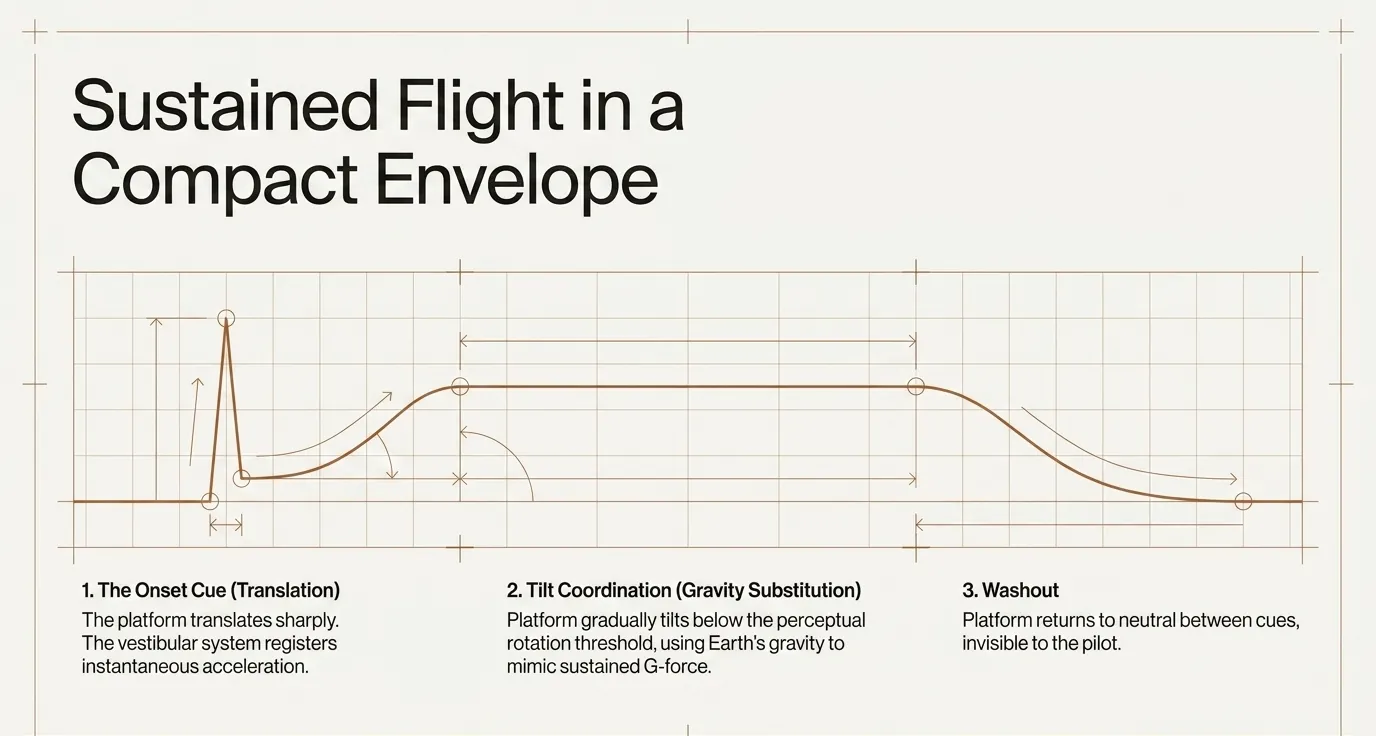
The road is long and the platform is not. The washout filter gives the onset, recovers the travel, and returns the platform toward center slowly enough that the return is not itself a cue. What fidelity means and how it is measured: the Motion Fidelity Thesis. Why the range feels larger than the numbers: the motion envelope chapter.
Software · data
Software that can write to a network socket, such as PsychoPy, MATLAB, Python, LabVIEW or ROS, can send it commands; building that integration is your work. Your poses run at the platform's 1 kHz game-to-motion rate, a command rate, not a telemetry rate: send your own poses.
The packet and the operation modes are in the integration and API chapter; three ways to drive it sets them out by team.
For departments and labs
Riders are 18 and over.
Tune a loop. Feel the overshoot. Three courses that can share one teaching platform.
Published. Scriptable. Open. Direct drive.
Four builds, from the platform alone to the PDK + ARK Ecosystem.
The PDK is supplied for evaluation and development under the Development Kit Evaluation Agreement; institutional use needs a separate academic license. Write to us with what you are planning. Development kits starting at $4,899.99.
Order a development kitContact ›
Built to allocation · delivery expected January to April 2027; delays of up to 12 months are possible