Venues
VR arcades, escape rooms and free-roam sites. 1.00 × 1.00 m per rig for the PDK platform, 1.20 × 1.00 m for the PDK Racer, with multi-rig synchronisation over the open interface for shared scenes.
Industries · Immersive
Immersive media has a physiological problem: the brain notices when the motion the eyes see and the motion the inner ear feels do not match. Adding a motion platform can fix that. It can also make it worse, and which one you get is mostly a question of timing.
The timing question ›Where it fits ›Your engine, your motion logic ›
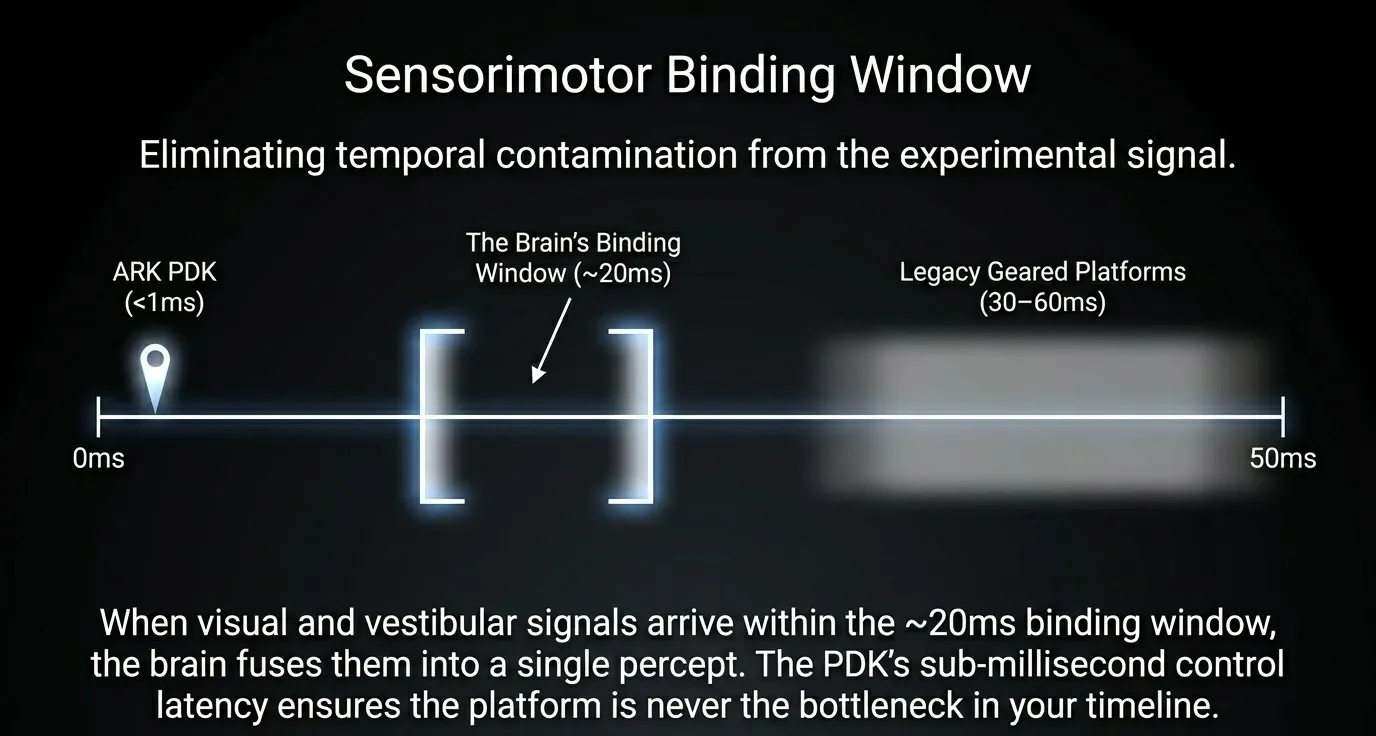
The timing question
When the visual and vestibular signals arrive close enough together, they fuse into one percept and you simply feel that you are moving. When they arrive far enough apart, they stay two signals that disagree, and the disagreement is what people describe as discomfort. That is why adding motion to an experience is not automatically an improvement — a platform that arrives late has added a second conflicting cue rather than resolved the first one.
Where it fits
VR arcades, escape rooms and free-roam sites. 1.00 × 1.00 m per rig for the PDK platform, 1.20 × 1.00 m for the PDK Racer, with multi-rig synchronisation over the open interface for shared scenes.
Industrial safety, scenario work and emergency-response rehearsal, with motion scripted alongside the visual content rather than bolted on afterwards.
Visuo-vestibular conflict paradigms, vection, and mismatch tolerance, with documented per-axis specifications and reproducible delivery.
Your engine, your motion logic
Immersive work is built on Unity, Unreal, OpenXR runtimes and bespoke engines. The platform does not ask you to add another layer to that stack.
Any engine or runtime that can emit a six-axis pose over UDP drives the platform. There is no proprietary motion SDK in the path and no plug-in you have to keep current.
The platform has no opinion about your headset. It receives a pose; what is rendering the scene is your business.
Commercial operation needs a Commercial Operator Agreement (Terms, Section 8), not on sale yet — register interest.
Static rig and user weight is carried pneumatically rather than by the motors, which is what makes a duty cycle of back-to-back sessions a thermal non-event.
Keep reading
Which two points, measured how — the page this one depends on.
The same platform where throughput and uptime decide the economics.
For a deployment, a protocol, or a question a page cannot answer.