Antenna and satcom
Check how a stabilised antenna holds lock and rejects wave-induced depointing, against a motion profile you can run again identically tomorrow.
Industries · Maritime
A vessel does not just roll. Crossing a wave it drops, slides sideways and lunges forward while rolling, pitching and yawing — all at once. Reproducing that on a bench needs six axes, because any subset of them is a different motion than the one the hardware will actually meet.
Why six ›The work it suits ›What a desk-scale rig does not test ›
Why six
Hardware that has to work at sea meets heave, sway and surge simultaneously with roll, pitch and yaw, and it is the combination that breaks things — a stabiliser that holds against roll alone can lose lock the moment the deck also drops. A platform that reproduces two axes convincingly is testing a motion the equipment will never actually see.
The work it suits
Check how a stabilised antenna holds lock and rejects wave-induced depointing, against a motion profile you can run again identically tomorrow.
Mount a motion reference unit or dynamic-positioning gyro to a scripted profile and compare its output against a commanded ground truth before it goes to sea.
A desk-scale bench for developing and stress-testing active heave compensation control before committing to full-scale hydraulics.
Profiles can be scripted to cycle the standard World Meteorological Organization sea states. That is a reference scale we drive the platform against — not a certification, and not a claim that the platform reproduces any given state to a stated tolerance.
The boundary
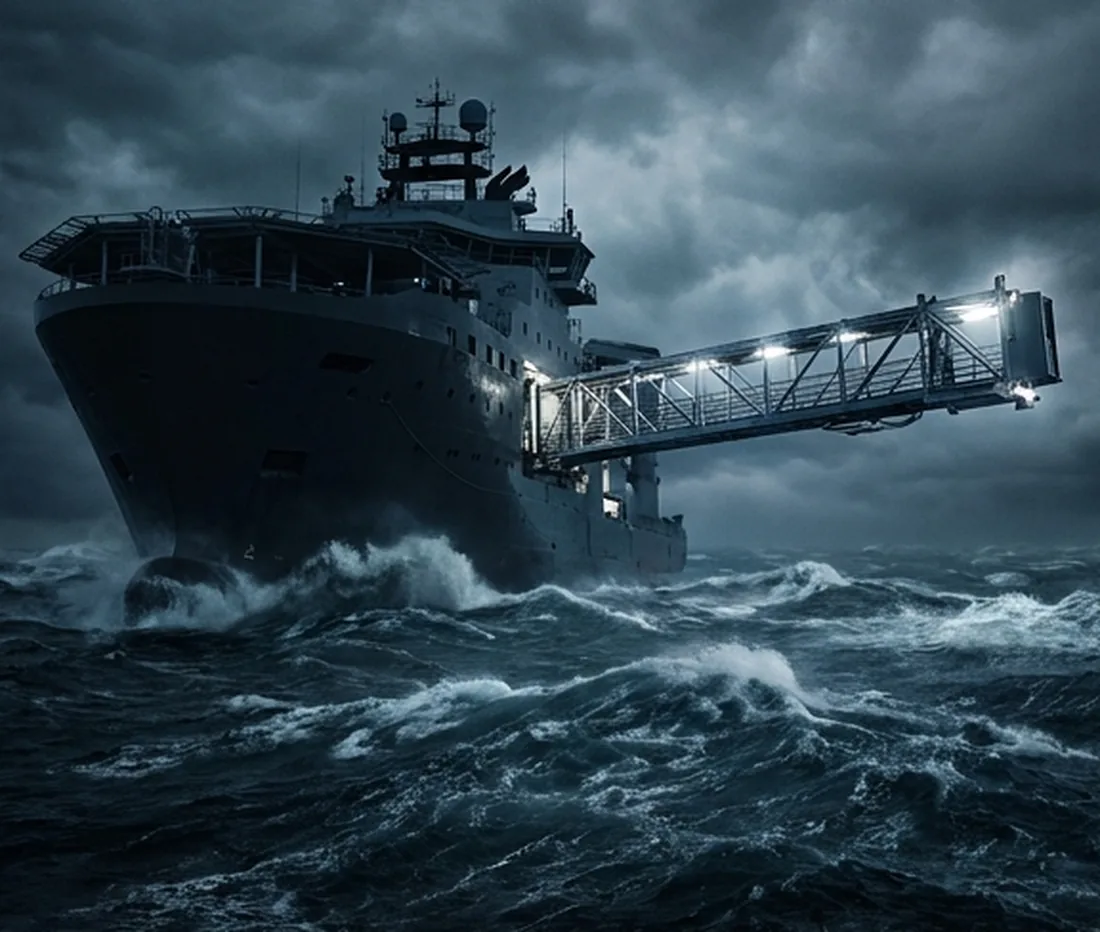
The base under a motion-compensated gangway is a Stewart platform, and so is this one. The architecture is genuinely the same, and that similarity is useful — a control engineer can develop and argue about compensation algorithms on real six-axis hardware rather than in simulation alone.
It is not the same machine. A walk-to-work system moves tonnes through metres against real sea loads with hydraulics sized for it. This platform moves a bench payload through a compact envelope. It will let you test whether your control law behaves, whether your sensor reads what you expect, and whether your compensation converges. It will not tell you what your full-scale actuators will do under load.
We would rather say that here than let a reader infer the wrong thing from a shared architecture. The overlap is the algorithm and the geometry. The overlap is not the scale.
Keep reading
The geometry this whole page rests on, and what it costs.
The neighbouring page: the same bench, judged on engineering tolerances.
For an installation, a syllabus, or a question a page cannot answer.